
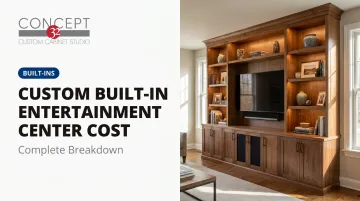
The challenge is that costs vary dramatically. A modular setup assembled from flat-pack components might run $2,000–$5,000. A fully custom, solid-wood build with integrated lighting, Aventos lift hardware, and precision installation can reach $25,000 or more. Knowing what drives that range is the difference between budgeting smart and being blindsided mid-project.
This guide breaks down every cost tier, the factors that push prices up or down, and the mistakes that derail most budgets before a single cabinet is cut.
Key Takeaways
- Custom built-in entertainment centers range from $2,000 (modular) to $25,000+ (fully custom solid wood)
- Labor typically accounts for 40–67% of total project cost — the most underestimated budget line
- Material choice drives both upfront cost and longevity — solid wood outlasts particleboard by decades
- Electrical work, design fees, and finishing are separate line items that must be budgeted independently
- A free in-home consultation provides a site-specific estimate, which is the only figure that reflects your actual project
How Much Does a Custom Built-In Entertainment Center Cost?
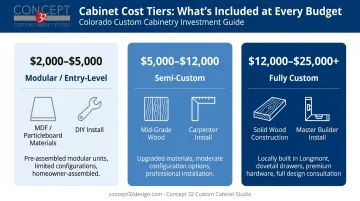
No fixed price exists for a custom built-in entertainment center. Every project differs by scope, materials, and who builds it. According to Fixr, the national average sits at $9,000, with a typical range of $5,000–$15,000 and high-end builds reaching $30,000. Here's how the numbers stack up across three tiers.
| Tier | Typical Range | Materials | Installation |
|---|---|---|---|
| Modular / Entry-Level | $2,000–$5,000 | MDF, particleboard | DIY or handyperson |
| Semi-Custom | $5,000–$12,000 | Mid-grade wood or painted MDF | Carpenter or cabinetmaker |
| Fully Custom | $12,000–$25,000+ | Solid wood, premium hardware | Master builders |
Modular / Entry-Level: $2,000–$5,000
This tier covers prefabricated or flat-pack cabinetry assembled on-site. Think big-box store units — MDF or particleboard construction, limited customization, basic hardware, standard finishes. Installation is typically DIY or handled by a handyperson.
Best for: Renters transitioning to ownership, first-time homeowners on a tight timeline, or rooms where the entertainment center isn't the design focal point.
Once you're ready for a tailored fit — and materials that hold up longer — the semi-custom tier becomes the more practical choice.
Semi-Custom: $5,000–$12,000
Cabinets built to fit your specific wall dimensions using mid-grade wood species or painted MDF. This tier includes cable management features, basic lighting options, and more design flexibility. Installation is by a carpenter or cabinetmaker who can handle non-standard wall configurations.
Best for: Homeowners who want a tailored look and better materials without commissioning a fully custom design.
When the entertainment center needs to match the quality and finish of custom kitchen or bathroom cabinetry elsewhere in the home, fully custom is the appropriate tier.
Fully Custom: $12,000–$25,000+
At this level, the build is designed around your wall, your wood species, and your hardware choices. Fully custom builds include:
- Solid wood construction (oak, maple, walnut)
- Dovetail drawer boxes
- Aventos vertical lift hardware for TV panels
- Integrated LED or motion lighting
- Specialty finishes and hardware
- Precision installation by master builders
Custom cabinetry components alone run $2,800–$6,400 installed, and per-linear-foot pricing for custom cabinetry ranges from $900–$2,500 depending on species and configuration.
Best for: Long-term homeowners, whole-home renovations where the entertainment center must match custom kitchen or bathroom cabinetry in quality and finish.
Key Factors That Affect the Cost
The price of a built-in entertainment center is shaped by design, material, site, and labor variables — and the spread between a basic unit and a full media wall can be substantial.
Size and Wall Scope
A compact 6-foot unit costs a fraction of a floor-to-ceiling installation spanning 12+ feet. Every additional linear foot adds material and labor hours. Full-wall media walls — which include integrated TV mounts, integrated lighting, and decorative shelving — require significantly more fabrication time than a standalone console.
Material and Wood Species
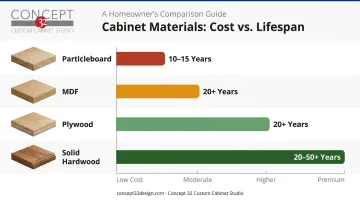
Material choice drives more of the budget than almost any other variable. Here's how the options stack up:
| Material | Cost Position | Lifespan |
|---|---|---|
| Particleboard | Lowest (40–60% cheaper than wood) | 10–15 years |
| MDF | Budget-friendly, paint-ready | 20+ years (structural) |
| Plywood | Mid-range, moisture-resistant | 20+ years |
| Solid hardwood (oak, maple, walnut) | Highest | 20–50+ years |
Wood species also carries real cost variation. Black walnut runs $8–$9 per board foot versus red oak at $4–$5.50 — roughly double the material cost for a premium aesthetic and distinctive color.
Level of Customization and Special Features
Each add-on increases both material and labor cost:
- Aventos vertical lift mechanisms for smooth, counterbalanced TV panel or storage bay access
- Integrated LED or motion lighting with wiring embedded directly into cabinet panels
- Glass-front cabinet doors for a display-ready finish with added fabrication complexity
- Custom wine racks, especially common when the unit connects to a home bar setup
- Specialty hardware including soft-close hinges, premium drawer pulls, and custom crown molding profiles
Labor and Installation Type
A general handyperson and a master builder are not interchangeable here. Precision cutting, fitting to non-square walls, matching existing trim profiles, and integrating lighting wiring all require skilled labor.
Specialty carpenters charge $40–$100/hour for built-in entertainment center work. Labor typically accounts for 40–67% of the total project cost, making it the most consistently underestimated budget line.
Electrical and Site Prep Work
Outlet relocation, dedicated circuits for lighting or AV equipment, and any drywall modification before installation are typically quoted separately. Adding or relocating an electrical outlet costs $138–$320 on average, with electricians charging $50–$120/hour depending on the scope.
Complete Cost Breakdown: What You're Actually Paying For
The total cost is the sum of distinct components. Budget for each one separately.
| Line Item | Typical Cost Range | Notes |
|---|---|---|
| Cabinetry and Materials | $2,800–$15,000+ | Largest single line item; scales with size and material grade |
| Design and Consultation | $0–$1,500 | Some studios include in project cost; Concept 32 offers a free in-home consultation |
| Labor and Installation | $40–$100/hr | Covers demo, fitting, mounting, leveling, trim-out |
| Electrical Work | $138–$600+ | Outlet relocation, lighting wiring, permit fees |
| Hardware, Finishing, Paint | $500–$3,000+ | Crown molding, pulls, soft-close hinges, stain or paint, caulking |
| Ongoing Maintenance | Minimal | Hardware tightening, finish touch-ups; solid wood lasts significantly longer |
Design services deserve specific mention. Concept 32 Custom Cabinet Studio in Longmont, for instance, includes free in-home consultations as the starting point — covering site-specific space planning, field measurements, and design discussions at no upfront cost. That process produces a real number based on your actual room, not a ballpark estimate.
Budget vs. Premium Built-Ins: What's the Real Difference?
The price gap between a $3,000 modular unit and a $15,000 fully custom built-in comes down to real, measurable differences in materials, fit, and longevity.
| Factor | Budget / Modular | Fully Custom |
|---|---|---|
| Construction material | Particleboard or low-grade MDF | Solid hardwood throughout |
| Fit precision | Standard dimensions | Built to exact wall measurements |
| Hardware | Basic hinges, fixed shelves | Soft-close, Aventos lift, adjustable |
| Lighting | None or add-on | Integrated LED/motion, wiring embedded |
| Expected lifespan | 10–15 years | 20–50+ years |
Particleboard is 40–60% cheaper upfront, but it warps with moisture, cannot be refinished, and typically needs replacement within a decade. Solid wood can be sanded, stained, or repainted multiple times over its lifespan.
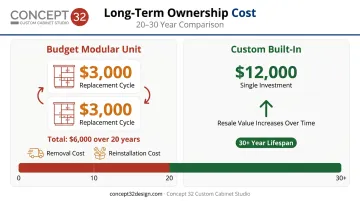
The long-term math matters. A $3,000 unit replaced twice over 20 years costs $6,000 — before factoring in removal and reinstallation each time. A $12,000 custom build lasting 30+ years can carry a lower total cost of ownership and adds measurable resale value that a big-box unit simply doesn't.
What Most People Get Wrong When Budgeting
Three planning mistakes account for most entertainment center budget overruns. Catching them early is straightforward — but only if you know to look.
Ignoring Labor Costs
The cabinet price is not the project price. Installation, electrical prep, and finishing work can add 40–60% on top of material costs. That gap is the most common source of budget shock, and it's entirely avoidable with an honest upfront estimate.
Mismatching Feature Grade to Build Grade
Adding motorized panels or specialty glass doors to a particleboard structure creates a mismatch — the hardware won't outlast the box it's mounted in. The reverse is equally problematic: choosing a budget build for a high-traffic living room that's meant to anchor the space for 20 years typically means a full replacement within a decade.
Skipping the Design Phase
A floor-to-ceiling entertainment center without professional design review risks:
- Poor room proportions that make the unit feel oversized or awkward
- Inadequate TV height clearance for the actual viewing distance
- Conflicts with existing trim, HVAC vents, or electrical outlets
Relocating an outlet or re-scribing cabinetry after installation runs $300–$800+ per fix — several times the cost of a design consultation upfront.
Frequently Asked Questions
How much does a custom built entertainment center cost?
Costs range from $2,000–$5,000 for modular units to $12,000–$25,000+ for fully custom solid-wood builds. The final number depends on wall size, material grade, features, and whether professional design and installation are included.
Is a built-in entertainment center worth the investment?
For long-term homeowners, yes. Built-ins eliminate freestanding furniture, integrate with the home's architecture, and can last the life of the home when built from quality materials. Custom cabinetry can also increase resale value by 10–15% in comparable home contexts.
How long does it take to build and install a custom built-in entertainment center?
Fully custom builds typically require 8–12 weeks from order to installation, with total design-to-completion timelines extending to 14–20 weeks. Semi-custom options move faster at 4–8 weeks, depending on project complexity.
What wood types are best for a custom built-in entertainment center?
Oak and maple offer excellent durability and accept paint or stain equally well. Walnut costs more but delivers a distinctive look with easy workability. MDF is a budget-friendly, paint-ready alternative, though solid wood outlasts it under heavy use and humidity swings.
Can I add electrical outlets or lighting to a built-in entertainment center?
Yes, and it's strongly recommended. In-cabinet outlets, LED lighting strips, and motion-activated lighting are all standard features on custom builds. Electrical work should be scoped early in the project — it's typically handled by a licensed electrician as a separate line item.
What is the difference between a custom built-in and a modular entertainment center?
Modular units use standardized dimensions and pre-made parts. Custom built-ins are designed and fabricated specifically for your wall's exact dimensions, style, and specifications. The result is a precise fit, higher material quality, and a significantly longer lifespan.
The Right Number Starts with the Right Conversation
Custom built-in entertainment centers range from $2,000 for basic modular setups to $25,000+ for fully custom, locally crafted solid-wood builds. The final number is the product of size, materials, features, labor, and electrical requirements — not any single line item in isolation.
For homeowners in Boulder County and across the Northern Front Range, the most accurate way to budget is through a professional, site-specific consultation. Concept 32 Custom Cabinet Studio in Longmont offers free in-home consultations where a designer visits your space to assess wall dimensions, existing finishes, electrical infrastructure, and style preferences. That hands-on assessment is what produces a number you can actually build a budget around.
Call 303-682-4052 or visit the showroom at 117 S Sunset St G, Longmont, CO to get started.