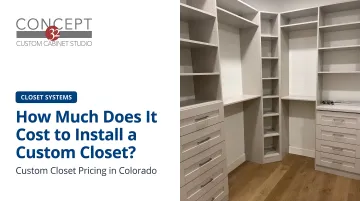
But "custom closet" covers a massive price range. A basic reach-in system might run $1,200. A boutique walk-in with built-in lighting, a central island, and glass-front cabinetry can top $20,000. Most projects land somewhere between $2,500 and $5,000 — but only if you understand what's actually driving the cost.
This guide breaks down exactly what you'll pay, what moves the price up or down, and how to avoid the budgeting mistakes that catch most homeowners off guard.
Key Takeaways
- Reach-in custom closets typically cost $1,200–$5,000; walk-ins run $5,000–$10,000; luxury systems can reach $20,000
- Size, materials, and customization level drive costs more than any brand name
- NAR's 2025 Remodeling Impact report found closet renovations return 83% of costs at resale
- A free in-home consultation is the most reliable way to get an accurate estimate — Concept 32 Custom Cabinet Studio offers these at no cost
How Much Does a Custom Closet Cost?
Custom closet costs vary widely based on size, materials, and how much design work the space requires. Understanding the pricing tiers upfront helps you budget accurately and choose the right system — not just the cheapest one.
According to Fixr's 2025 cost data, most custom closet projects fall between $2,500 and $5,000, with a national average of $3,500. The low end starts around $1,200; high-end boutique systems can reach $20,000. Pricing is typically quoted at $17–$50 per square foot or $150–$450 per linear foot for professionally installed systems.
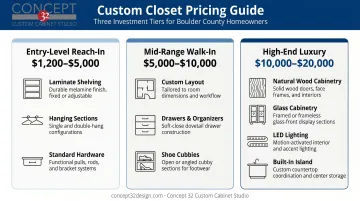
| Tier | Typical Range | What's Included |
|---|---|---|
| Entry-Level (Reach-In) | $1,200–$5,000 | Laminate/MDF shelving, partitioned hanging sections, standard hardware |
| Mid-Range (Walk-In) | $5,000–$10,000 | Custom layouts, thermally fused laminate or plywood, drawers, shoe cubbies |
| High-End (Luxury) | $10,000–$20,000 | Natural wood/cedar, glass-front cabinetry, integrated island, LED lighting |
Entry-Level: Reach-In Custom Closets ($1,200–$5,000)
A standard 6–8 ft reach-in with basic laminate or MDF shelving, partitioned hanging sections, and standard hardware falls into this range. No frills — but a meaningful upgrade from wire shelving.
Best for:
- Secondary bedrooms and guest rooms
- Budget-conscious homeowners or anyone upgrading a chaotic reach-in for the first time
- Sellers staging a home to improve buyer appeal
Mid-Range: Walk-In Custom Closets ($5,000–$10,000)
This tier covers professionally designed layouts with thermally fused laminate or plywood construction. Expect dedicated hanging sections, drawers, and shoe cubbies. Many homeowners in this range eliminate a bedroom dresser entirely by building drawer systems directly into the closet.
Best for:
- Master bedroom upgrades focused on long-term functionality
- Anyone wanting a system that organizes — not just stores
- Homeowners ready to invest in a layout designed around how they actually use the space
High-End: Luxury Custom Closets ($10,000–$20,000)
Premium builds use cedar, natural wood veneer, or glass-front cabinetry paired with integrated LED or motion-sensor lighting, built-in islands, and jewelry storage. Everything is built to exact dimensions. These closets function more like a dedicated room than a storage space.
Best for:
- Large master suite renovations or new construction builds
- Homeowners who want the closet to serve as a design feature
- Anyone expecting the investment to add measurable resale value
Key Factors That Affect Custom Closet Installation Costs
Pricing reflects real decisions you make about size, materials, and design complexity. Understanding these four levers lets you control your budget without sacrificing what matters most.
Closet Type and Size
Size is the most direct cost driver. More linear footage means more shelving, more cabinetry, and more labor. Reach-in closets are the most affordable option, covering a single wall of storage. Walk-ins span multiple walls, while boutique closets are essentially small rooms outfitted floor to ceiling.
Most professional providers price by the linear foot of wall space being configured.
Materials and Build Quality
Material choice affects both upfront cost and long-term durability. Here's the spectrum:
| Material | Installed Cost (per linear ft) | Best For |
|---|---|---|
| Laminate | $125–$150 | Budget builds, easy cleaning |
| MDF | $140–$240 | Painted finishes, smooth look |
| Melamine | $135–$175 | Mid-range, durable surface |
| Plywood | $150–$500 | Structural strength, longevity |
| Cedar | $200–$500 | Premium, natural scent |
| Natural Wood Veneer | $200–$1,200 | Luxury finish, showpiece closets |
Concept 32 Custom Cabinet Studio's systems — manufactured locally in their Boulder County studio by master builders — use solid wood construction and dovetail drawer joinery, which puts them firmly in the mid-to-premium tier of the table above.
Level of Customization and Add-Ons
Off-the-shelf modular systems save money but leave dead corners and awkward gaps. Fully custom-built cabinetry, designed to exact dimensions, maximizes every inch — especially critical in smaller or irregularly shaped spaces.
Common add-ons that raise the total project cost:
- Built-in lighting: $200–$2,000 (sensor lights to recessed LED)
- Closet island: $1,000–$2,500
- Shoe racks: $50–$75 each
- Jewelry storage: $75–$150
- Mirrors: $100–$300
- Drawers: $75–$200 per unit
Deciding which add-ons matter most before the design phase keeps the project on budget. Lighting and islands tend to have the biggest impact on both usability and final cost.
Installation Labor and Prep Work
Labor rates typically run $40–$120/hour depending on complexity and region. Most professional closet companies bundle labor into the total project quote rather than billing it separately.
Prep work is often a separate cost not included in the base closet price:
- Demolition of old shelving: $200–$600
- Integrated LED lighting: $200–$800
- Permits (rarely required unless structural/electrical changes): $50–$300
Local manufacturing — like Concept 32's Boulder County studio — cuts out the shipping delays and added costs tied to overseas flat-pack suppliers, which keeps both timelines and pricing more predictable.
Breaking Down the Full Cost of a Custom Closet
A complete custom closet budget covers more than just shelving. Here's how the costs break down:
- Materials and cabinetry: The largest line item — shelving, cabinet boxes, drawer fronts, hardware, and specialty features. Costs scale with material quality and total linear footage.
- Design and installation: Most professional studios bundle design and installation into one quote. Concept 32 includes free in-home consultations with every project, so there's no separate design fee.
- Add-ons and accessories: Priced individually and optional. Deciding on these upfront prevents budget surprises later.
- Ongoing maintenance: Custom closets are low-maintenance. Budget $50–$100 for occasional hardware tightening. Major repairs like warped shelving or refinishing run $200–$800, but are rare with quality construction.
Budget vs. High-End: What's the Real Difference?
The gap between a $2,000 reach-in and a $15,000 boutique walk-in isn't just aesthetics.
Here's where the real differences show up:
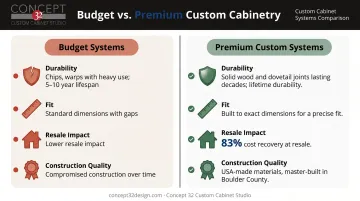
- Durability: Budget laminate and wire systems chip, warp, and loosen with heavy daily use. Premium systems — solid wood, commercial-grade board, dovetail drawer joints, soft-close hardware — hold up for decades. Concept 32 builds at this tier, with solid wood cabinetry and dovetail drawer construction standard.
- Fit: Entry-level systems rely on standard dimensions, leaving gaps and dead corners. Custom systems are built to your exact space — a real advantage in smaller or oddly shaped closets.
- Resale value: NAR's 2025 Remodeling Impact report found closet renovations return 83% of their cost at resale. Primary bedroom walk-in closets now top buyers' wish lists — they'll shrink a home office or dining room before giving up closet space.
- Lifespan: Budget systems often need replacing in 5–10 years. A well-built custom system can last the life of the home.
How to Set the Right Budget — And What Most People Get Wrong
Factors That Should Shape Your Budget
- How long you plan to stay: Longer tenure = worth investing more in durability and finish
- Current condition of the space: Does demo or electrical work need to happen first?
- Number of users and actual storage needs: A shared master closet for two people has different requirements than a guest room reach-in
- Whether you're replacing a dresser: Adding built-in drawers significantly changes project scope
Common Mistakes That Blow Budgets
- Focusing only on materials without accounting for labor, design, or electrical prep
- Over-specifying features you won't actually use (a large island in a small walk-in is a waste)
- Choosing the cheapest option without evaluating build quality, warranty, or installer reputation
- Skipping the design consultation — which leads to layouts that don't match how you actually use your space
A free in-home consultation is the most reliable way to get an accurate number for your specific space. Concept 32 Custom Cabinet Studio offers complimentary consultations for homeowners across Boulder County, Denver metro, Fort Collins, Loveland, and the Northern Front Range. Designers assess the space directly, and because all cabinetry is manufactured locally in Longmont, the estimate you receive reflects real lead times and actual build quality — not catalog guesses. The goal is a budget that solves your storage problem, holds up over time, and fits your home.
Frequently Asked Questions
How much does custom closet installation cost?
Most professionally designed and installed custom closets fall between $2,500 and $5,000, with a national average around $3,500. Reach-in systems start near $1,200; full walk-ins can reach $10,000 or more depending on size, materials, and features selected.
What is the difference in cost between a reach-in and a walk-in custom closet?
The gap comes down to scale and complexity. Reach-in closets use a single wall of storage with a compact footprint, while walk-ins span multiple walls and require significantly more materials, hardware, and labor hours to complete.
What are the most affordable materials for a custom closet?
Laminate and MDF are the most budget-friendly options, running roughly $125–$240 per linear foot installed, while still offering a polished, painted finish in a wide range of colors. Cedar and natural wood veneer are premium alternatives at significantly higher price points.
Is it worth hiring a professional to install a custom closet instead of doing it yourself?
DIY can save on labor, but measuring, cutting, and assembly errors are costly to fix. Professional installation ensures a precise fit and structural integrity, and most installers back their work with a workmanship warranty that DIY projects simply don't carry.
How long does a custom closet installation take?
Most custom closet projects run 4–6 weeks from design finalization to installation. The physical installation itself is faster: reach-in closets take half a day to one day; walk-ins take one to two days; boutique room-size closets may take three to four days.
Do custom closets increase home value?
Yes. NAR's 2025 Remodeling Impact data shows closet renovations recover roughly 83% of costs at resale. Walk-in closets in master suites tend to have the strongest impact on buyer appeal and purchase decisions.