

The good news: you don't need to build an addition or sacrifice living space to fix it. Converting a section of your attached garage into a functional mudroom is one of the most practical upgrades a homeowner can make. A well-designed 6–10 foot wall section handles the transition from outdoors to indoors without the mess bleeding into the rest of the house.
This guide covers everything you need to get it right — layout planning, storage essentials, material choices, and why custom cabinetry outperforms off-the-shelf options in the long run.
Key Takeaways:
- The garage entry is most families' primary entry point — designing it intentionally makes daily life measurably easier
- A 6–8 foot wall section is enough for a fully functional mudroom with seating, hooks, and storage
- Vertical zoning (shoes low, coats mid, seasonal gear high) is the organizing principle that makes small spaces work
- Durable, moisture-resistant materials are non-negotiable in Colorado's climate
- Custom cabinetry outlasts flat-pack alternatives in demanding garage environments
Why Your Garage Is the Best Place for a Mudroom
Most families don't use their front door. According to DASMA, 45% of homeowners with garages said the garage door was their primary point of entry, compared to just 35% for the front door. That same research found 89% used the garage for regular daily entry — making the garage-side threshold the most trafficked spot in the house.
That behavioral reality makes the garage the logical place for a mudroom. The transition from outdoors to indoors is already happening there — the only variable is whether your storage is set up to handle it.
A few other reasons the garage wins:
- Installs without structural changes — a surface-mounted storage wall (bench, hooks, cabinets) requires no permit in Denver, Longmont, or Boulder County (though always verify with your local municipality before starting)
- Handles wet gear naturally — concrete floors and unfinished walls hold up to muddy boots and damp equipment better than any carpeted interior room
- Uses space that's already going to waste — even a two-car garage has wall space near the interior access door that sitting idle
The U.S. Department of Energy reports that 66% of occupied U.S. housing units have a garage or carport — meaning most homeowners already have the infrastructure. They just haven't put it to work yet.
How to Plan Your Garage Mudroom Layout
Step 1: Assess Your Available Space
Start by measuring the wall nearest the interior access door. Note the traffic path between the garage door and the house entry — your mudroom zone shouldn't interrupt that flow or eat into parking clearance.
This Old House's modular cubby build used units 80 inches tall, 16 inches deep, and just under 24 inches wide per section. Four sections for a family of four fits in roughly 8 linear feet — a realistic slice of most garage walls.
Step 2: Map Your Family's Actual Storage Needs
Before selecting anything, think through what actually comes through that door:
- Kids' gear — backpacks, sports bags, cleats, helmets (that will change as they grow)
- Seasonal rotation — ski boots and parkas in winter, hiking shoes and baseball gear in spring
- Pet supplies — leashes, towels, wipes, waste bags
- Adult daily use — work bags, reusable grocery bags, car keys
When each person has a dedicated zone, gear stops piling up at the door — and the space stays usable even on chaotic mornings.
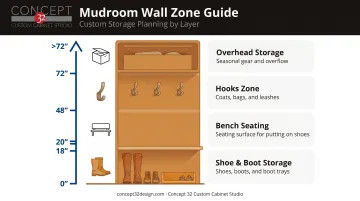
Step 3: Zone the Space Vertically
Small spaces get more functional when you think in layers, not just footprint:
| Zone | Height | What Goes Here |
|---|---|---|
| Lower zone | Floor to 18" | Shoes, boots, boot trays |
| Seating zone | 18"–20" | Bench surface |
| Hook zone | 48"–72" | Coats, bags, leashes |
| Upper storage | 72"+ | Seasonal gear, overflow |
Step 4: Check Your Lighting
Garage lighting is rarely designed with a mudroom corner in mind. Before finalizing your layout, check whether existing fixtures cover the area adequately.
A poorly lit entry is a real safety concern — especially when kids are navigating wet floors and gear in winter. Plan for any additional lighting early, because the logical installation sequence is:
- Cabinets and large built-ins
- Shelving units
- Hooks, accessories, and task lighting to fill gaps
Must-Have Storage Solutions for a Family-Friendly Garage Mudroom
Seating and Shoe Storage
A bench anchors the mudroom. It's where bags drop, shoes come off, and the shift from outdoor to indoor actually happens. Choose one with built-in storage underneath — drawers, a lift-up seat, or open cubbies keep the footprint compact while adding real function.
For shoes specifically, the options are:
- Open lower shelving — easy access, good airflow, quick to use
- Individual cubbies — one per family member, clear ownership
- Pull-out drawers — cleaner look, keeps shoes contained
- Boot trays — essential for wet footwear; contain snowmelt and mud before it spreads
Assigning a dedicated spot per person is what separates a mudroom that works from one that slowly becomes a pile.
Hooks, Hangers, and Wall-Mounted Systems
Wall-mounted hook rails are the workhorses of any mudroom. Positioning them at two heights makes a real difference:
- Lower hooks (42"–48") — sized for kids, so they can hang their own gear
- Upper hooks (60"–66") — adult height for coats, bags, and heavier items
When kids can reach their own hooks, things actually get hung up instead of dropped on the floor.
Slatwall panel systems offer a significant advantage over fixed hook rails: they're reconfigurable. Concept 32 Custom Cabinet Studio builds slatwall into their mudroom and built-in solutions for exactly this reason: a Colorado household's storage needs in ski season look nothing like they do in summer. Reconfiguring for camp gear, sports equipment, or hiking packs takes minutes instead of a renovation.
Bins, Baskets, and Small Item Storage
Open baskets and labeled bins handle the small stuff that inevitably accumulates: hats, gloves, scarves, dog supplies, sunscreen. For a mudroom environment, stick to:
- Mesh or plastic bins — wipe-clean, washable, won't absorb moisture
- Labeled containers — per person or per category, either works
- Lidded bins for upper shelves — keeps seasonal items dust-free and contained
Avoid fabric baskets near the floor. Wet boots and damp gear will ruin them quickly.
Why Custom Built-In Cabinetry Makes All the Difference
Off-the-shelf storage has a fundamental problem: it's designed for no space in particular. The result is mismatched pieces that don't fit your wall dimensions, don't match your home's aesthetic, and wear out faster than you'd expect — particularly in a garage environment where temperature swings, humidity, and heavy daily use are the norm. Custom-built cabinetry addresses all three at once.
What Custom Configurations Actually Look Like
A well-designed garage mudroom cabinet system typically combines:
- Tall locker-style units with full-height hanging space for coats and boot storage below
- Base cabinets with drawers for small accessories, pet supplies, and daily-carry items
- A built-in bench with integrated storage — seating and function in one cohesive unit
- Upper cabinets that keep out-of-season gear enclosed, off the floor, and out of the way
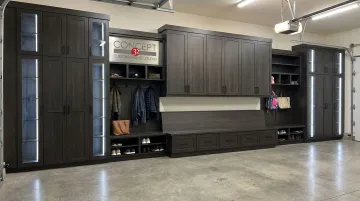
Concept 32's Denver mudroom project on Gilpin St. shows what this looks like in practice: a dark wood bench, wall-mounted hooks, and clean lines that read as a designed space rather than assembled storage.
The Durability Case
Consumer Reports notes that stock cabinets often rely on thinly veneered particleboard, while premium cabinets use 3/4-inch plywood shelves and solid wood frames — a meaningful difference in a garage where particleboard will absorb moisture, sag under load, and degrade within a few years.
Concept 32's cabinets feature dovetail drawer construction and solid wood options built to handle daily punishment. For Colorado homeowners, that durability matters across seasons: freezing winter temperatures, wet spring snowmelt, and the low-humidity swing of summer all stress cabinet materials in ways particleboard simply can't handle.
The Fit and Finish Advantage
A custom system fills your wall exactly — no filler strips, no awkward gaps, no compromised storage. Concept 32 manufactures all cabinetry in their Boulder County studio, building each piece around your specific garage dimensions and your household's actual storage requirements.
Their free in-home consultation is the starting point. A designer visits your space, assesses the layout, and develops a system built around what your family needs — not a catalog approximation of it.
Choosing Materials That Can Handle Mud, Snow, and Heavy Use
Colorado's climate puts real stress on a garage mudroom. Temperature swings, snowmelt on boots, and high-humidity spring conditions all push materials past what standard home finishes can handle.
Flooring
The mudroom floor takes the worst of it. Options in order of durability:
- Sealed concrete — already there in most garages; QUIKRETE's concrete sealer creates a water-resistant finish that's easy to clean and maintain
- Porcelain tile — defined by TCNA as having water absorption of 0.5% or less, frost-proof, highly stain and scratch resistant; excellent choice if you're willing to do proper installation
- Luxury vinyl plank — waterproof, softer underfoot, easier to install; verify freeze-thaw tolerance for your specific product before installing in an unheated garage
- Rubber floor mats — lower cost, easy to swap out, effective for moisture containment at the entry threshold

Regardless of flooring choice, boot trays near the entry are non-negotiable. They contain snowmelt at the source.
Walls and Hardware
- Use moisture-resistant drywall (like USG Mold Tough panels) near wet storage areas — standard drywall won't last
- Sealed drywall with moisture-resistant paint works fine for lower-traffic wall sections
- Choose rust-resistant hardware — stainless steel, galvanized steel, or aluminum. Wet boots and road salt will destroy standard steel hooks quickly
Mats and Runners
3M's entrance matting research confirms that entrance mats remove and trap dirt and moisture before it spreads into the home. An absorbent runner at the garage-to-house threshold captures what the floor mats miss — protecting your interior flooring from whatever the garage brings in.
The Finishing Touches That Make It Feel Like Home
A garage mudroom doesn't have to feel like a utility space. A few additions transform it from functional to genuinely welcoming:
- Absorbent runner rug at the entry threshold — moisture control and comfort underfoot
- Mirror — practical for last-minute checks before leaving; also makes the space feel larger
- Charging station — if existing outlets are nearby, a small drawer or shelf dedicated to device charging keeps phones and tablets out of the kitchen
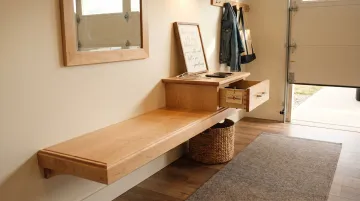
The details that reflect your family are what separate a mudroom from a storage closet:
- Label cubbies or hooks per family member — this creates accountability and makes it easier for kids to maintain their own spaces
- Coordinate basket colors or cabinet finishes to match the interior of the home rather than treating the mudroom as an afterthought
- A small piece of wall art or a family name sign ties the space to the rest of the home
The mudroom only stays functional if it's maintained. A simple routine — weekly wipe-down of surfaces, seasonal purge of outgrown or unused gear — prevents the slow creep of clutter that undoes even a well-designed system.
Frequently Asked Questions
How much does it cost to add a mudroom to a garage?
Costs range from a few hundred dollars for freestanding off-the-shelf storage to $2,800–$13,000+ for a fully custom built-in system. The variables are size, materials, and construction quality.
Do I need a permit to build a garage mudroom?
In Denver, like-for-like storage additions that don't alter the floor plan, structure, or electrical/plumbing systems generally don't require a permit. However, rules vary by municipality — Boulder County and Longmont have their own thresholds. Always verify with your local building department before starting work.
What is the ideal size for a garage mudroom?
Even a 6–8 foot section of one garage wall can accommodate a fully functional mudroom with a bench, hooks, and storage. The key is efficient vertical use of wall space rather than floor area. For a family of four, roughly 8 linear feet handles dedicated storage per person comfortably.
How do I organize a garage mudroom for multiple kids?
Assign each child a dedicated cubby, locker section, or set of hooks — ideally labeled with their name. Clear ownership is what makes the system stick — kids are far more likely to use a space that belongs specifically to them.
What's the difference between a built-in and freestanding mudroom setup?
Freestanding solutions are easier to install and can be moved, but they rarely fit the wall exactly and wear out faster. Built-in cabinetry uses vertical wall space more efficiently, looks more polished, and is built to the precise dimensions of your garage.
How do I prevent moisture and mold in a garage mudroom?
Keep indoor relative humidity below 60% (ideally 30–50%) and dry wet materials within 24–48 hours. In practice: use boot trays for wet footwear, maintain adequate ventilation, and run a dehumidifier during Colorado's wet spring and snowmelt season.