The tension is real, though. Custom cabinetry costs more and takes longer than stock options pulled off a warehouse shelf. Yet according to NAHB, kitchen remodeling ranked as the second most common remodeling project in 2025 — and a growing share of those projects center on custom cabinetry as the primary investment.
This article breaks down the practical, day-to-day reasons why that choice keeps making sense: better use of space, materials built to last, design that actually coheres, and long-term value that stock options simply don't deliver.
Key Takeaways
- Custom cabinets are built to your kitchen's exact dimensions — no filler strips, no wasted corners
- Solid wood construction and precision joinery outlast particleboard alternatives by decades
- Every detail is configurable: wood species, finish, door profile, hardware, and specialty features like lift systems or motion lighting
- Quality cabinetry is among the most recognized resale value drivers in a kitchen remodel
- A design consultation covering workflow, storage habits, and layout is what makes the investment pay off
What Is Custom Cabinetry?
Custom cabinetry means cabinets designed, built, and installed specifically for your space — not selected from a catalog of predetermined sizes. Every dimension is shaped by the actual kitchen, not by what standard manufacturing happens to produce.
In a modern kitchen remodel, custom cabinetry applies across the full scope of the space:
- Upper and lower cabinets along every wall run
- Kitchen islands and peninsula configurations
- Floor-to-ceiling pantry walls
- Appliance integration panels for built-in refrigerators and dishwashers
- Specialty storage like pull-out organizers, wine racks, and coffee station builds
The result is a kitchen that functions precisely the way your household needs it to — no workarounds, no wasted corners, no cabinets that almost fit. That precision is exactly why custom cabinetry keeps showing up at the center of serious kitchen remodels.
Key Advantages of Custom Cabinetry in Modern Kitchen Remodels
The advantages below aren't theoretical. They show up in how efficiently a kitchen runs, how long the cabinets hold up, and what the home is worth when it eventually sells.
Perfect Fit for Every Kitchen Layout
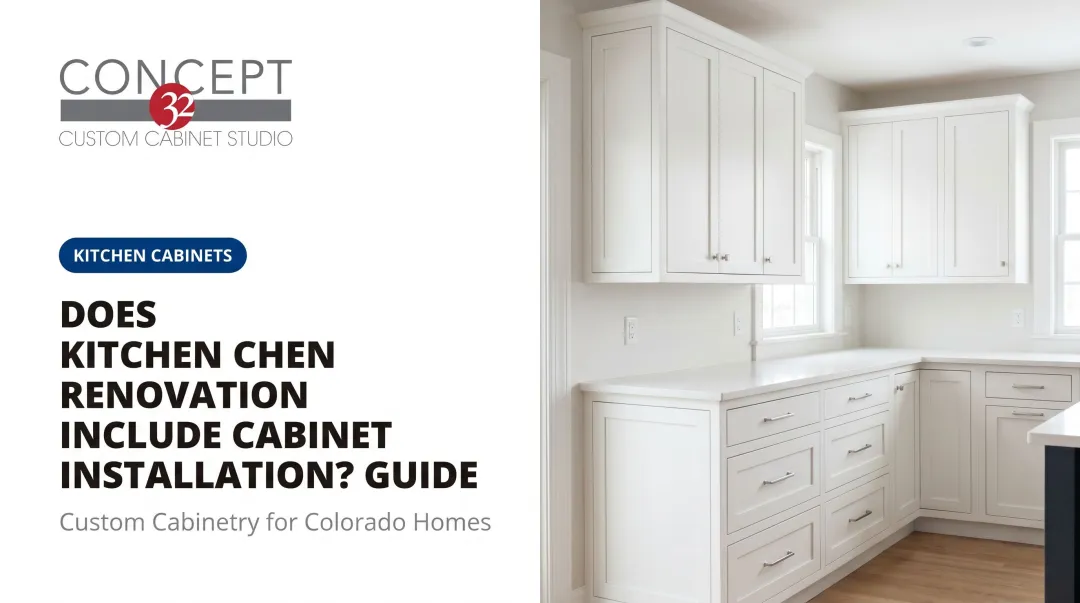
Stock cabinetry assumes standard kitchens. Older homes with sloped ceilings, irregular wall angles, and open-concept layouts where every inch affects the room's visual weight — none of these fit neatly into catalog dimensions.
Custom cabinetry solves this at the source. Every cabinet is built to the exact measurements of the space, which means:
- No filler strips patched between cabinet runs and walls
- No awkward gaps above cabinets or around appliances
- No dead corners requiring lazy-susan workarounds
- Storage that runs floor to ceiling and wall to wall
Wasted kitchen space isn't just an aesthetic problem. Dead corners and shallow wall runs translate directly into cluttered countertops and frustrated prep workflows. When everything has a precise, logical place, the kitchen becomes genuinely easier to use and clean.
Research from the Harvard Joint Center for Housing Studies found that homeowners of properties built before 1980 spent 24% more on improvements in 2023 than owners of homes built since 2010. That spending gap reflects a real constraint: older homes weren't built to modern kitchen dimensions, and stock cabinetry doesn't bridge that gap the way custom solutions do.
Layout-fitting is especially critical in pre-1980 homes, kitchens with islands or peninsula configurations, and open-concept spaces where cabinetry forms part of the room's visual architecture — not just its storage function.
Superior Craftsmanship and Long-Term Durability
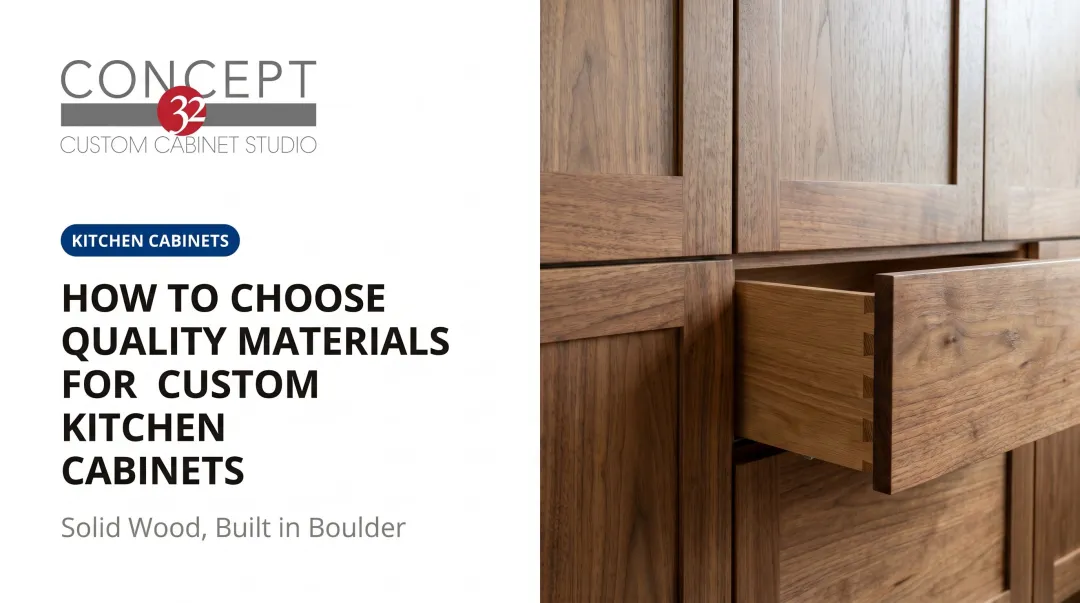
The durability gap between custom and stock cabinetry starts with materials. Stock cabinets rely on particleboard or MDF-core boxes with stapled joints, while custom cabinets use solid wood frames, plywood boxes, and precision joinery — dovetail drawer construction being the most recognized example.
Those construction differences compound over time. Solid wood doesn't warp or delaminate under kitchen humidity the way particleboard does. Soft-close hinges and full-extension drawer glides specified in a custom build stay functional for years beyond the hardware found in box-store cabinet lines.
InterNACHI's home component life expectancy chart lists kitchen cabinets at an estimated 50-year lifespan — a benchmark that quality construction makes achievable, and that cheaper materials make aspirational at best.
At Concept 32 Custom Cabinet Studio, cabinets are manufactured locally in their Longmont, Colorado studio by master builders using solid wood construction and dovetail drawers. Mass production can't replicate that level of hands-on craftsmanship — and it shows in the finished product.
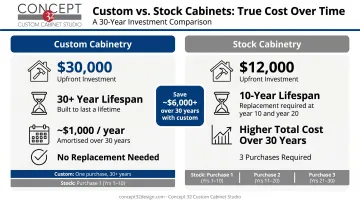
The cost-per-year math: When amortized over a longer lifespan, custom cabinets often cost less annually than cheaper alternatives that require repair or full replacement within a decade. A $30,000 custom install lasting 30+ years runs less per year than a $12,000 stock remodel replaced at the 10-year mark.
This calculation matters most in high-use kitchens, homes where owners plan to stay 10+ years, and remodels where cabinetry is meant to be a permanent upgrade — not a placeholder until the next renovation.
Design Flexibility and Modern Kitchen Features
Custom cabinetry delivers on two fronts simultaneously: aesthetic personalization and functional innovation. Neither is available at the same depth through stock options.
On the aesthetic side, homeowners can select:
- Wood species and grain direction
- Stain or paint finish (from light naturals to bold two-tone schemes)
- Door profile — shaker, flat-panel, inset, and beyond
- Hardware style and finish
This level of control ensures the cabinetry complements countertops, flooring, and the broader design language of the home rather than competing with it. Kitchens that feel designed rather than assembled read differently — both to the people who cook in them daily and to buyers who walk through during a sale.
On the functional side, custom cabinetry unlocks features that stock options simply can't offer:
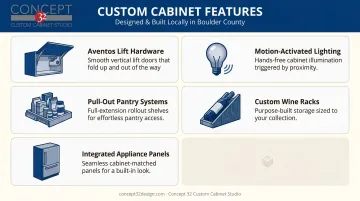
- Aventos vertical lift hardware on upper cabinets — doors that fold up and out of the way rather than swinging open, ideal for open-concept kitchens where traditional door clearance creates flow problems
- Motion-activated lighting inside cabinet interiors, so deep pantry shelves and corner storage are actually visible
- Pull-out pantry systems and rollouts that make every inch of depth accessible
- Custom wine racks built seamlessly into the cabinet run rather than added as freestanding units
- Integrated appliance panels that give built-in refrigerators and dishwashers a consistent, furniture-like appearance
Concept 32's portfolio includes a Nederland Kitchen where a coffee maker and double oven are neatly integrated into the cabinetry — the kind of seamless appliance incorporation that requires custom planning from the start, not a retrofit.
When this matters most: Design flexibility pays off most when the kitchen opens into living or dining areas (where cabinetry is always visible), when homeowners have specific aesthetic preferences that stock catalogs can't satisfy, or when the remodel involves unique storage needs that require purpose-built solutions.
What Happens When You Skip Custom Cabinetry
The consequences of choosing stock or semi-custom cabinetry in a non-standard kitchen aren't always obvious at the showroom — they show up after installation.
Common practical outcomes:
- Cabinets that don't reach the ceiling, leaving a dust-collecting gap that looks unfinished
- Filler strips between cabinet runs and walls that read as patches rather than intentional design
- Appliance gaps that require trim kits and workarounds
- Corners that are either dead storage space or require accessories that don't quite fit
These fit issues are just the beginning. The deeper costs emerge over time.
The Long-Term Cost Problem
Cheaper cabinet boxes swell under kitchen humidity, drawer faces warp, and hinges fail earlier than expected. Repair costs accumulate, and full replacement often arrives sooner than anyone planned — frequently exceeding what custom cabinetry would have cost originally.
The Design Fragmentation Risk
Stock cabinets chosen from a catalog rarely align with countertop edges, backsplash tile dimensions, or flooring transitions the way purpose-built cabinetry does. The result is a kitchen that feels assembled from parts rather than designed as a whole — which diminishes both daily enjoyment and resale appeal.
How to Get the Most Value from Custom Cabinetry
Custom cabinetry delivers its full value when the process starts well before any cabinet is built.
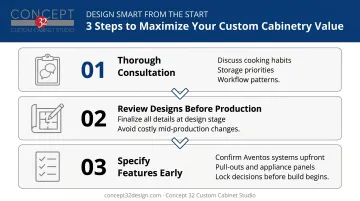
- Start with a thorough consultation — not just measurements, but a real conversation about how the kitchen is actually used: cooking habits, traffic flow, storage priorities, where clutter accumulates, and what the household genuinely needs
- Review designs carefully before production begins — changes at the design stage cost nothing; changes after manufacturing starts cost significantly more
- Be specific about specialty features early — Aventos lift systems, pull-out pantry configurations, and integrated appliance panels all require planning at the design stage, not as afterthoughts
That planning process is easier with the right design partner. Homeowners in Boulder County, Denver metro, and the Northern Front Range can schedule a free in-home consultation with Concept 32 Custom Cabinet Studio. Their designers work through each of these steps with you directly — and all cabinets are manufactured locally in Longmont, CO by master builders.
Conclusion
What makes custom cabinetry worth the investment becomes clear once homeowners are actually living in the kitchen — better organization, less daily friction, and a space built around how they cook, store, and move.
The advantages compound. Superior materials and craftsmanship extend the investment across decades. A cohesive design adds enduring value that buyers recognize and respond to. And a kitchen built around how a household actually lives is more enjoyable to use.
Custom cabinetry is a long-term home decision, not a cosmetic upgrade. The design partner you choose determines whether it delivers on all of those fronts. Concept 32 Custom Cabinet Studio offers free in-home consultations for homeowners across Boulder County, Denver, and the Northern Front Range — a good starting point if you're planning a kitchen remodel and want cabinetry built to last.
Frequently Asked Questions
Why do people get custom cabinets?
Homeowners choose custom cabinets to get a precise fit for their specific kitchen layout, superior material quality, and personalized design options that stock or semi-custom cabinets can't match. The combination of exact dimensions, better construction, and tailored features makes the kitchen function the way the household needs it to.
What is the newest trend in kitchen cabinets?
Current trends include flat-panel and shaker door styles in bold two-tone color schemes, integrated appliance panels that give built-in refrigerators and dishwashers a seamless furniture-like appearance, and functional hardware like Aventos vertical lift systems on upper cabinets. Motion-activated interior lighting is also gaining traction for both usability and visual appeal.
Are custom cabinets worth the extra cost over stock options?
For homeowners planning to stay long-term, custom cabinets typically offer better cost-per-year value because of superior durability, and they contribute to a more cohesive kitchen that holds resale appeal. Stock cabinets that require early replacement or repair often end up costing more over a 15–20 year window.
How long does it take to get custom cabinets made and installed?
Timelines vary by project complexity, design finalization, and material sourcing. Working with a local manufacturer like Concept 32, where all cabinets are built in our Longmont studio, can shorten lead times compared to imported options. Contact us directly for a current timeline estimate for your specific project.
Can custom cabinets be designed to fit awkward or non-standard kitchen layouts?
Yes, and it's one of the primary reasons homeowners choose custom cabinetry. Skilled designers can accommodate sloped ceilings, irregular wall angles, tight corners, and unusual room proportions that standard cabinet sizes cannot address without filler strips and workarounds.
What materials are best for custom kitchen cabinets?
Solid wood (maple, oak, cherry, and similar species) paired with plywood box construction offers the best balance of durability and aesthetics. Construction details like dovetail drawer joints and soft-close hardware extend the cabinet's lifespan and daily usability — and are standard features in quality custom builds.