Whether cabinet installation is included depends entirely on how your project is structured, who you hire, and what their contract actually says. A general contractor running a full remodel will typically coordinate cabinet supply and installation as part of the scope. A homeowner who sources cabinets separately and manages individual trades will need to contract installation as its own line item.
This guide covers what a full kitchen renovation actually includes, what the cabinet installation process looks like step by step, what it costs, and how to make smart decisions about sequencing and cabinet selection — so you're not caught off guard mid-project.
Key Takeaways
- Cabinet installation is part of nearly every kitchen renovation, though it's sometimes contracted separately
- Cabinetry accounts for 30%–40% or more of your total renovation budget — the single largest cost category
- Upper cabinets are installed before base cabinets — not the other way around
- Flooring sequence depends on material type; floating floors should always go in after cabinets
- Always ask for an itemized, written scope of work before signing anything
Does a Kitchen Renovation Always Include Cabinet Installation?
The short answer: yes, in most full kitchen renovations. But "included" depends entirely on how your project is structured.
The Three Common Project Structures
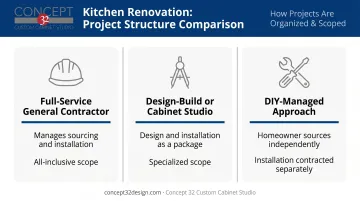
Most homeowners fall into one of these three setups:
- Full-service general contractor — manages everything, including sourcing and installing cabinets. Installation is typically included in the overall scope.
- Design-build or cabinet studio — handles design and installation as a package. Cabinet scope is clearly defined and often more specialized.
- DIY-managed approach — the homeowner sources cabinets independently and hires separate installers. Installation must be contracted and budgeted separately.
According to the 2024 U.S. Houzz Kitchen Trends Study, 84% of kitchen renovators hire at least one professional, with 55% hiring a general contractor and 35% working with a cabinetmaker directly. The remaining homeowners manage specialty providers without a single project manager — which means more coordination falls on them.
What's Often NOT Automatically Included
Even in a "full renovation" package, these items frequently require separate contracts or line items:
- Appliance delivery and hookup
- Plumbing rerouting
- Electrical work for under-cabinet lighting
- Permit fees
- Specialty custom interior accessories
The fix is straightforward: ask your contractor or cabinet studio one direct question before signing anything. "Does your quote include full cabinet removal, installation, leveling, hardware fitting, and final walkthrough?" That single question prevents most mid-project budget surprises.
Buying cabinets from a retailer or online does not include installation. If you're sourcing your own cabinets separately from your contractor, budget installation as a standalone cost.
What a Full Kitchen Renovation Typically Includes
A full kitchen renovation covers all core elements: cabinets, countertops, flooring, lighting, plumbing fixtures, appliances, backsplash, and finishing details like trim and paint. Cabinets anchor the renovation because every other element (countertops, lighting placement, even flooring) gets sequenced around them.
Budget Allocation
Angi reports that cabinetry is consistently the largest single expense, accounting for 30%–40% or more of the total budget. HomeAdvisor data puts labor at roughly 25% of costs, with electrical work at approximately 5% and design fees around 3%.
A reasonable budget breakdown for a full renovation might look like this:
| Category | Approximate Budget Share |
|---|---|
| Cabinetry | 30%–40% |
| Labor/installation | ~25% |
| Appliances | 10%–15% |
| Countertops | 10%–15% |
| Flooring | 5%–7% |
| Lighting/electrical | ~5% |
| Plumbing fixtures | 4%–6% |
| Backsplash | 3%–5% |
| Contingency | 10%+ |
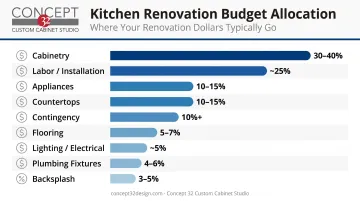
Angi recommends a contingency buffer of at least 10% for unexpected repairs. In practice, hidden costs like drywall patching behind old cabinets, disposal fees, and delivery charges for custom orders make that buffer essential, not a nice-to-have.
Cabinet Scope in a Full Renovation
Under a complete renovation, cabinet work typically covers:
- Removal and disposal of old cabinets
- Wall preparation (patching, leveling, stud marking)
- Installation of base and upper cabinets
- Hardware fitting (hinges, pulls, drawer glides)
- Final walkthrough with adjustments
Crown molding, under-cabinet lighting, and custom interior accessories are often quoted as add-ons. Before finalizing your scope, it's worth confirming which elements of your project require a permit.
Permits: What Requires One and What Doesn't
In Boulder County and Denver, finish work — cabinets, countertops, flooring, and painting — does not require a permit when replacing like-for-like. Permits are required for:
- Floor plan alterations or wall removal
- Plumbing rerouting or new fixture locations
- New or relocated electrical circuits
- Any structural modifications
Skipping a required permit can complicate a future home sale, so confirm your scope with your local building department before work begins.
The Cabinet Installation Process: What to Expect
Pre-Installation Preparation
Before any cabinets go up:
- Clear appliances and belongings from the kitchen
- Confirm final cabinet layout and measurements
- Check walls and floors for levelness
- Coordinate any electrical or plumbing adjustments with the installer
The Installation Sequence
Professional installers follow a specific sequence, and skipping steps creates real problems. According to This Old House and Angi's installation guide, the correct order is:
- Locate studs and mark reference lines on walls and floors
- Secure a ledger/cleat to the wall to support upper cabinets during installation
- Install upper cabinets first, starting from a corner, using the cleat for support
- Install and level base cabinets, shimming as needed to create a perfectly level foundation
- Fit doors, drawer fronts, hinges, and hardware, adjusting alignment and soft-close mechanisms
- Final cleanup and walkthrough — checking alignment, spacing, and function
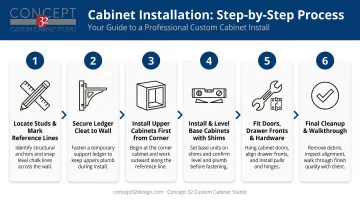
Upper cabinets go in before base cabinets for a practical reason: working overhead with base cabinets already in place is difficult and risks damaging finished surfaces.
After Cabinets Are Set
Once cabinets are installed and confirmed complete, countertop templating can begin — Lowe's schedules measurements only at that point for exactly this reason. For custom countertops, IKEA estimates 2–3 weeks from purchase to installation. From there, the sequence continues: plumbing hookup, backsplash, lighting, trim, and paint.
A realistic full timeline from cabinet delivery to move-in readiness is 8–12 weeks according to Angi, and longer if the project involves structural changes or permit review. Knowing this sequence upfront helps you plan trades and avoid costly delays.
How Much Does Cabinet Installation Cost?
Cabinet costs have two components: the cabinets themselves and the labor to install them.
Cabinet Costs by Type
| Cabinet Type | Cost Range (Installed) | Lead Time |
|---|---|---|
| Stock | $100–$300 per linear foot | 1–5 weeks |
| Semi-custom | $90–$650 per linear foot | 5–6 weeks |
| Custom | $500–$1,200 per linear foot | 8 weeks–6 months |
Sources: Bob Vila 2023, This Old House 2026
For an entire kitchen, Angi puts the average cabinet installation cost at $6,194, with most homeowners spending between $1,935 and $10,766 depending on kitchen size and cabinet type.
Additional Cost Factors
Budget for these separately if they apply to your project:
- Demolition and disposal of existing cabinets
- Complex layouts — islands, corner cabinets, tall pantry units add labor time
- Wall or floor repairs discovered during demo
- Specialty upgrades — pull-out shelves, custom wine racks, Aventos vertical lifts, motion lighting
Each of these can shift your total by hundreds to thousands of dollars, so treat them as separate line items from the start — not afterthoughts.
Why Itemized Quotes Matter
Get multiple written quotes from contractors and cabinet studios. The lowest bid without a detailed scope of work is often the most expensive project by the time it's finished.
Ask each contractor to break out the following separately:
- Materials and cabinet type
- Labor and installation
- Demolition and disposal
- Hardware and permit fees
That level of detail makes bids comparable — and protects you from surprise costs mid-project.
Cabinets or Flooring First?
This is one of the most common sequencing questions in kitchen renovation, and the answer depends on your flooring material.
The Case for Cabinets First (Most Common Approach)
- Protects new flooring from construction traffic and tool damage
- Reduces material costs — flooring only needs to cover visible areas, not under base cabinets
- Provides a stable subfloor surface for precise cabinet leveling
When Flooring First Makes Sense
- Homeowners anticipating future layout changes — full flooring underneath means cabinets can be repositioned without patching floors later
- Appliances that need to sit flush with surrounding cabinetry
The Material Decision Guide
| Flooring Type | Recommended Sequence |
|---|---|
| Hardwood | After cabinets (reduces damage risk) |
| Floating laminate / LVP | After cabinets — heavy cabinets can cause buckling |
| Tile | Either order; consult your installer |
Floating floors should never have heavy cabinets placed on top of them — they need room to expand and contract with temperature changes. Before either trade starts work, confirm the sequence with both your cabinet installer and your flooring installer — a quick conversation between them can prevent costly corrections later.
Choosing the Right Cabinets for Your Kitchen Renovation
Stock vs. Semi-Custom vs. Fully Custom
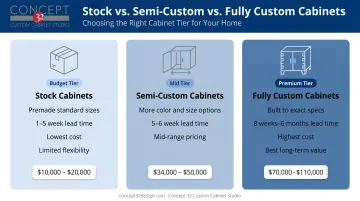
- Stock cabinets — premade in standard sizes, fastest lead time (1–5 weeks), lowest cost, limited sizing flexibility
- Semi-custom cabinets — more color and size options within standard increments, 5–6 week lead time, mid-range pricing
- Fully custom cabinets — built to exact specifications, widest range of features and materials, 8 weeks to 6 months lead time, highest cost but best long-term value
According to the 2024 Houzz Kitchen Trends Study, 76% of homeowners chose solid wood as the primary cabinet material, with plywood accounting for another 22%.
What Separates Quality Custom Cabinets
High-quality custom cabinets go well beyond a solid wood box. The construction details that actually matter:
- Dovetail drawer joints resist racking far better than stapled or doweled construction; rated up to 100 lbs on full-extension soft-close glides
- 3/4-inch plywood carcasses hold up against moisture and weight where particleboard or MDF eventually fail
- Pull-out shelves, rollouts, spice racks, and custom wine racks built into the cabinet layout (not retrofitted after)
- Aventos vertical lifts open overhead doors upward rather than outward — practical above countertops and islands
- Motion-activated interior lighting that turns on when doors open
For homeowners in Boulder County and the Northern Front Range of Colorado, Concept 32 Custom Cabinet Studio in Longmont builds fully custom, USA-made cabinetry in their local studio by master builders. Every cabinet is designed to your home's exact dimensions — there are no stock or semi-custom tiers.
Design, manufacturing, and installation are handled through one studio. The process starts with either a 15-minute phone call or a free in-home visit. Their showroom at 117 S Sunset St G, Longmont, CO 80501 has material samples, color swatches, and completed displays so you can make decisions with something tangible in front of you. Reach them at 303-682-4052.
Frequently Asked Questions
What is included in a full kitchen remodel?
A full kitchen remodel typically covers cabinet removal and installation, countertop replacement, flooring, lighting and electrical updates, plumbing fixtures, appliances, backsplash, and finishing details like trim and paint. Cabinets are the anchor element — all other trades sequence around them.
How much should I expect to pay to have kitchen cabinets installed?
Cabinet installation labor and materials range from $100–$300 per linear foot for stock cabinets and $500–$1,200 per linear foot for custom, according to Bob Vila. Angi puts the average total project cost at $6,194, with a range of $1,935–$10,766. The cost of the cabinets themselves is a separate and highly variable figure.
What is the most expensive part of a kitchen remodel?
Cabinetry. It consistently accounts for 30%–40% or more of the total renovation budget — more than appliances, countertops, or labor individually. Custom cabinets demand durable materials, precise construction, and a design that works for your specific space — all of which add up.
Is $30,000 enough for a kitchen remodel?
It depends on your kitchen size and goals. The national average for a minor remodel runs $26,945–$27,492 (HomeAdvisor 2025; JLC Cost vs. Value 2024), so $30,000 is near that ceiling. A major full-cabinet-and-appliance replacement climbs to a national median of $55,000 — and in the Denver metro, a midrange major remodel averages $79,702.
How long does kitchen cabinet installation take during a renovation?
Professional cabinet installation typically takes 2–3 days for a standard kitchen. The full renovation runs much longer — Angi estimates 8–12 weeks of active construction, plus 2–4 weeks each for planning and permitting if required.
Should I hire a general contractor or a cabinet specialist for my kitchen remodel?
For projects involving structural changes, multiple trades, or plumbing and electrical rerouting, a general contractor is better suited to manage coordination. For the cabinetry itself — which is the most impactful element of any kitchen remodel — a dedicated cabinet studio or design-build firm offers deeper design expertise and direct oversight of materials, construction methods, and how the finished cabinets function in your specific space.