](https://file-host.link/website/concept32design-h7dios/assets/refined-images/1782818220792000_e0b124d0005044a29dd0771ae749b4d5/360.webp)
That makes material selection consequential in a way that choosing a faucet finish simply isn't. Get the materials right, and cabinets built today can realistically last 50 years. Get them wrong, and you may be looking at warped boxes, failing drawer joints, or peeling finishes within a few years.
Unlike stock or semi-custom options, custom cabinetry puts every material decision in your hands — which is both the opportunity and the responsibility. This guide breaks down what to choose, where it matters most, and how to allocate your budget for maximum long-term value.
Key Takeaways
- Cabinet boxes, doors, drawer boxes, and shelving are separate components — and each can use a different material
- Plywood is the strongest choice for cabinet boxes; solid wood and MDF serve different door finish goals
- Solid wood drawer boxes with dovetail joinery are the durability benchmark for daily use
- Let moisture exposure, finish goals, and household habits drive material decisions — not price alone
- Invest in the box and drawer construction first; cosmetic upgrades are secondary
Understanding the Anatomy of Custom Kitchen Cabinets
A common mistake when evaluating cabinets is judging the whole unit by its door style. In reality, a kitchen cabinet is a system of distinct components — each with its own structural role and material requirements.
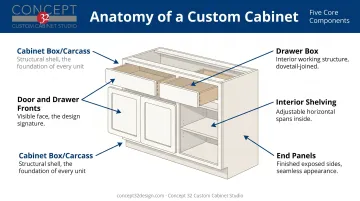
The five core components:
- Cabinet box (carcass) — The structural shell that supports countertops, hardware, and everything stored inside
- Door and drawer fronts — The visible face of the design; purely aesthetic but highly impactful
- Drawer box — The interior working structure that bears daily load from cookware, utensils, and groceries
- Interior shelving — Spans horizontal distances under real weight; rigidity matters more than appearance
- End panels — Finish exposed cabinet sides for a cohesive, built-in look
One additional structural consideration: frameless (European-style) cabinets rely entirely on the box itself for rigidity, since there's no face frame to add stiffness. That makes substrate quality even more critical in frameless construction than in traditional framed cabinets.
Knowing what each component does makes it easier to ask the right questions about materials — which is exactly where quality differences show up most.
Best Materials for Each Part of Your Custom Kitchen Cabinets
The most effective material strategy is part-by-part, not one-size-fits-all. Here's what performs best in each component.
Cabinet Box: Plywood vs. Particle Board
Plywood — built from cross-grained wood veneer layers bonded under pressure — is the standard recommendation for cabinet boxes in kitchens, and for good reason. USDA Forest Products Laboratory research confirms that particleboard and MDF have considerably lower screw-withdrawal resistance than solid wood or plywood of similar density. That matters every time a hinge, drawer slide, or installation fastener is driven into the box.
Plywood also handles humidity fluctuations better than particle board — a real consideration on Colorado's Front Range, where dry indoor air creates seasonal expansion and contraction cycles in wood products.
Particle board can perform acceptably in dry, low-traffic spaces like closets or built-ins. In kitchens — especially sink bases and dishwasher-adjacent cabinets — it carries meaningful risk: swollen edges from moisture exposure, weakened fastener points over time, and limited repairability if damage occurs.
Door and Drawer Fronts: Solid Wood vs. MDF
The right door material depends almost entirely on your intended finish.
Solid wood doors:
- Essential for stained finishes — real grain, depth, and species character can't be replicated
- Can be repainted or refinished over decades
- Expand and contract seasonally; five-piece frame-and-panel construction handles this better than wide one-piece solid panels
MDF doors:
- The Composite Panel Association describes MDF as flat, smooth, uniform, and free of knots — making it the strongest substrate for painted finishes
- Delivers a crisper, more uniform paint result than solid wood, especially on shaker profiles
- Lower impact resistance and sensitive to prolonged moisture; not suitable as a box material in wet zones
For a painted kitchen, MDF doors are a legitimate, practical choice. For a stained kitchen, there's no real substitute for solid wood.
Drawer Boxes: Where Quality Is Felt Every Day
Open and close a drawer a thousand times with cast iron pans stacked inside, and construction quality becomes impossible to ignore. Drawer boxes are the most tactile quality indicator in a custom cabinet.
Solid wood drawer boxes with dovetail joinery are the recognized benchmark. Consumer Reports identifies solid-wood drawers with dovetail joinery — paired with full-extension guides — as a defining characteristic of well-built cabinets. Premium drawer slide systems from manufacturers like Blum are tested to 100,000 open-close cycles at 75 lbs of load — a useful benchmark for the durability standard to expect from quality hardware.
When reviewing your custom cabinet proposal, confirm that dovetail drawer boxes are specified. It's a detail worth asking about directly.
Plywood drawer boxes with quality soft-close hardware also perform well. What to avoid: thin, stapled particle board drawer construction that shows failure quickly under real household load.
Interior Shelving and End Panels
Shelving is often underspecified, but it carries real consequences. Pantry shelves spanning 24 to 36 inches hold dishes, small appliances, and canned goods — and undersized thickness will cause sagging within a few years. A few specifications worth confirming:
- Plywood shelving outperforms particle board over longer spans
- ¾" thickness is the minimum for spans over 24 inches under heavy load
- Painted interiors benefit from a smooth, cleanable surface for daily maintenance
- End panels on exposed cabinet sides should match the door finish for a cohesive, built-in look
Key Factors to Consider When Choosing Cabinet Materials
Material selection isn't purely technical. It should be driven by how the kitchen is actually used, what the finish goals are, and where budget will have the greatest long-term impact.
Moisture Exposure and Room Conditions
Sink base cabinets, dishwasher-adjacent runs, and kitchens with heavy daily cooking activity face repeated humidity, steam, and occasional spills. In these zones, substrate choice is not cosmetic — it's structural.
No panel material — plywood, particle board, or MDF — should be described as waterproof. What varies is how each responds when moisture reaches it. In high-exposure zones, prioritize:
- Plywood box construction — cross-grain layers resist swelling and delamination better than particle board
- Moisture-resistant finishes — sealed edges and interior coatings slow moisture penetration significantly
- Proper ventilation design — cabinetry adjacent to dishwashers benefits from a small gap or finished panel to allow airflow
These details are what separate a cabinet that serves 20 years from one that warps or swells within five.
Painted vs. Stained Finish Goals
The finish goal should determine the door material — not the other way around:
- Stained finish → solid wood is required; the grain is the point
- Painted finish → either solid wood or MDF works; MDF often delivers a smoother, more uniform result
A practical lifestyle note: darker painted finishes show fingerprints and dust more readily than natural wood tones. For high-traffic family kitchens, lighter painted colors or stained wood finishes tend to conceal everyday wear better.
Wood Species for Stained Cabinets
For homeowners choosing stained cabinetry, species selection determines grain character, color tone, and stain absorption.
| Species | Character | Best For |
|---|---|---|
| Maple | Fine, uniform grain; creamy white tone | Contemporary, clean, light kitchens |
| White oak | Medium-coarse texture; distinct rays; warm brown | Transitional, rift-cut, warm-toned designs |
| Cherry | Close grain; rich reddish-brown; deepens with light | Traditional, refined, warmer aesthetics |
| Birch | Fine, uniform texture; light tone | Durable option; approve a stained sample first |
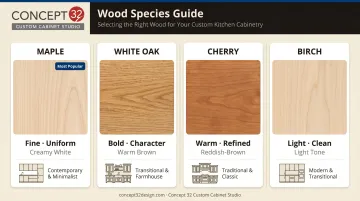
White oak has been gaining ground for good reason — Better Homes & Gardens' 2026 color forecast points to oak and walnut cabinetry in warm and medium brown tones as a leading design direction. For Colorado homes where natural materials and warm interiors are a consistent aesthetic thread, it's a well-timed choice.
Budget Allocation: Where to Invest First
A common rule of thumb suggests cabinets represent about one-third of a kitchen remodel budget. NAR's data puts the number higher: cabinetry accounts for 40% to 60% of total renovation cost for most kitchens, with custom cabinetry at the upper end of that range.
The practical implication: plan your cabinet budget first, then allocate the rest of the kitchen remodel around it.
Prioritize in this order:
- Cabinet box material — plywood over particle board in kitchens
- Drawer box construction — solid wood with dovetail joinery
- Hardware — soft-close slides and hinges from reputable manufacturers
- Door and finish selection — aligned with remaining budget and finish goals
- Cosmetic upgrades — decorative end panels, specialty features
These priorities hold whether you're working with a tight budget or a generous one — the box and drawer construction are what you'll feel every day.
Quality Signals to Look for When Evaluating Cabinets
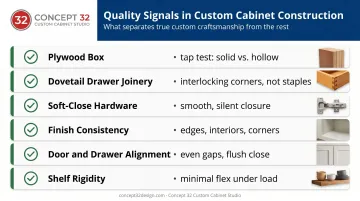
When comparing custom cabinet options, these are the observable details that separate quality construction from lower-grade alternatives:
- Plywood box construction — tap the sides; solid and rigid versus hollow and flexible
- Dovetail drawer joinery — visible interlocking joints at drawer corners, not staples or simple butt joints
- Soft-close hardware — drawers and doors should close smoothly without slamming
- Finish consistency — check inside corners, edges, and interiors, not just the face
- Door and drawer alignment — gaps should be even; doors should close flush without adjustment
- Shelf rigidity — press down on a loaded shelf span; minimal flex indicates sufficient thickness
How Concept 32 Custom Cabinet Studio Can Help
For homeowners across Boulder County, Denver, Fort Collins, and the Northern Front Range, Concept 32 Custom Cabinet Studio offers a genuine alternative to stock or semi-custom cabinets — every piece is designed and manufactured specifically for the home it's going into.
All cabinetry is built locally in their Boulder County studio by master builders, which means material quality and construction standards are controlled in-house rather than sourced from a distant supplier.
Cabinet designer Emily Vizzard works directly with clients through the full selection process — from cabinet box and drawer construction to door style, finish, and wood species, to specialty features like dovetail drawer boxes, Aventos vertical lifts, motion lighting, and custom wine racks.
Why Front Range homeowners choose Concept 32:
- All cabinets manufactured locally in Boulder County — made in the USA
- Dovetail drawers and solid wood construction available as custom options
- Whole-home design capability across kitchens, bathrooms, and closets
- In-house manufacturing means quality control never leaves the studio
- Free in-home consultation as the starting point for every project
The studio serves the full Front Range — from Greeley and Windsor to Lakewood, Broomfield, and Westminster. If you're weighing material options and want guidance from someone who builds what they recommend, a free in-home consultation is a practical first step.
Conclusion
Choosing quality materials for custom kitchen cabinets comes down to matching the right material to the right component, room conditions, finish goals, and how the kitchen actually gets used. Each part of the cabinet system has its own demands, and the best material for a face frame won't necessarily be the best choice for a drawer box or interior shelf.
The advantage of going custom is that these decisions don't get made for you. Unlike stock cabinetry, custom builds allow intentional choices that improve durability, daily function, and long-term home value. Working with an experienced local designer is the most reliable way to navigate those decisions and avoid the common mistake of investing in a beautiful finish built on the wrong substrate. Concept 32's Boulder County studio offers free in-home consultations, so those material conversations happen before anything gets built.
Frequently Asked Questions
What materials should I use for custom kitchen cabinets?
The best approach uses different materials for different components: plywood for the cabinet box, solid wood or MDF for doors (depending on whether the finish is stained or painted), and solid wood with dovetail joinery for drawer boxes. The right combination depends on the room's moisture exposure, the finish goal, and how intensively the kitchen is used.
What is the 1/3 rule for cabinets?
The 1/3 rule is a planning shorthand suggesting cabinets represent roughly one-third of a kitchen remodel budget. In practice, verified industry data from NAR puts cabinetry at 40% to 60% of total kitchen renovation cost — higher for custom cabinetry. Most custom kitchen budgets will allocate more than one-third to cabinetry.
Is plywood or particle board better for kitchen cabinets?
Plywood is the stronger and more moisture-tolerant choice for kitchen cabinet boxes, particularly near sinks, dishwashers, or in high-use kitchens. Particle board can work in dry, low-load applications like closets, but the performance gap between the two becomes most visible over time and under daily household conditions.
Are solid wood kitchen cabinets worth the extra cost?
For stained finishes and long-term durability, solid wood is the premium standard. It can be refinished, repaired, and repainted over decades in a way engineered materials cannot, and for homeowners planning to stay long-term, the added cost is typically justified by the lifespan and finish flexibility.
How do I know if my kitchen cabinets are good quality?
Look for these specific indicators: plywood box construction (not particle board), dovetail joinery on drawer corners, soft-close drawer slides and door hinges, consistent finish on all surfaces including interior edges, and doors and drawers that align squarely and close smoothly without adjustment.
What kitchen cabinet colors are trending for 2026?
Deep greens, earthy hues, and warm neutrals are gaining ground in painted kitchens, according to Architectural Digest's 2026 kitchen trend coverage. For stained cabinets, warm oak and walnut tones are the clear direction — painted colors pair well with MDF or paint-grade doors, while wood tones require stain-grade species like white oak or cherry.