Yet most homeowners approach this choice without a clear framework. Stock, semi-custom, custom — the terms blur together, the price ranges vary wildly, and the tradeoffs aren't obvious until you're already committed to a direction.
This article cuts through the confusion. You'll get a straightforward comparison of all three cabinet types, honest cost context, and a practical decision framework so you can choose confidently — whether you're renovating a 1960s ranch home in Boulder County or updating a Denver metro townhouse.
Key Takeaways
- Stock cabinets are pre-built, fast, and affordable, but fixed sizing leaves gaps in most real kitchens
- Semi-custom cabinets offer moderate personalization at mid-range prices; heavy modifications can push costs close to custom territory
- Custom cabinets are built to exact dimensions with premium materials, eliminating wasted space entirely
- Non-standard layouts, older homes, and long-term stays almost always favor custom cabinetry
- Homes with wood cabinetry and natural finishes sell for as much as 3.5% more, according to Zillow Research
Custom Cabinets vs. Stock Cabinets: Quick Comparison
Here's how stock, semi-custom, and custom cabinets compare across the factors that drive most buying decisions.
| Category | Stock | Semi-Custom | Custom |
|---|---|---|---|
| Cost (per linear foot) | ~$60–$400 | ~$100–$700 | ~$500–$1,200+ |
| Sizing | Fixed increments (3-inch jumps) | Standard increments, limited modifications | Built to exact dimensions |
| Design options | Set catalog of styles/finishes | Expanded choices within manufacturer catalog | Unlimited — any wood, finish, hardware, or fitting |
| Lead time | Days to 1–3 weeks | 4–8 weeks | 6–16 weeks depending on manufacturer |
| Construction | Particleboard/furniture board common | Varies; some include plywood boxes | Solid wood, dovetail joinery, premium hardware |
| Fit to space | Requires filler strips for gaps | Better fit, some gaps remain | Seamless — no fillers, no wasted corners |
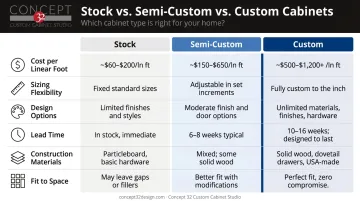
Cost ranges sourced from Angi's cabinet cost research. Your final cost will depend on brand, finish, dealer, and your local market.
What Are Stock and Semi-Custom Cabinets?
Stock Cabinets
Stock cabinets are pre-manufactured in fixed standard sizes, warehoused, and available for immediate purchase at big-box retailers. They're designed for speed and affordability — not personalization.
Standard cabinet widths start at 6 inches and expand in 3-inch increments, according to KraftMaid. In practice, this means most kitchens end up with filler strips, awkward corner gaps, or unused wall space when stock sizes don't align with actual wall dimensions.
Stock cabinets work well when:
- The kitchen has a simple, rectangular layout with standard dimensions
- The project is a rental property or investment flip
- Budget and timeline are the primary constraints
- A fast turnaround is required — many stock lines are available within 1–3 weeks
Semi-Custom Cabinets
Semi-custom cabinets are manufactured to order within a defined range of modifications. You can adjust height, width, and depth within limits, and you get broader finish and hardware options than stock — but you're still working within the manufacturer's catalog.
Some semi-custom lines, including certain KraftMaid special-order configurations, allow modifications down to 1/16-inch increments. That's significantly more precise than stock sizing, though it still doesn't match the complete freedom of a true custom build.
Each modification adds cost, and a heavily optioned semi-custom order can approach custom pricing — making full custom the smarter investment at that price point.
Semi-custom cabinets work well when:
- The layout is fairly standard but not perfectly rectangular
- The design goals are moderate — updated style without complete personalization
- Budget falls between stock and full custom
What Are Custom Kitchen Cabinets?
Custom cabinets are built from scratch to the precise specifications of your kitchen and your preferences. Every dimension, material, finish, and internal fitting is determined by your needs — nothing is constrained by a manufacturer's catalog.
Construction Quality
The construction gap between stock and custom is significant. According to Consumer Reports' cabinet buying guidance, well-built cabinets use solid wood or plywood boxes, dovetail or dowel joints, and full-extension drawer glides. Stock cabinets from mass-market retailers commonly use particleboard or furniture board construction — materials that absorb moisture, swell, and wear faster under daily use.
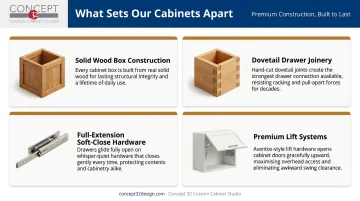
Custom cabinets typically include:
- Solid wood box construction instead of particleboard or MDF cores
- Dovetail drawer joinery, which is mechanically stronger and longer-lasting than stapled alternatives
- Full-extension, soft-close hardware on drawers and doors
- Premium lift systems like Blum's AVENTOS line, which allows upper cabinet doors to fold upward rather than swing out — ideal in tighter kitchen configurations
Design Freedom
With custom cabinetry, the design options are genuinely unlimited. Homeowners can specify:
- Wood species and grain direction
- Door profiles (shaker, flat-panel/modern, and more)
- Any paint color — including custom-mixed colors matched to the home's palette
- Interior fittings: rollouts, dividers, pull-out racks, wine racks, appliance garages with lift-up doors, coffee bar stations
- Integrated motion lighting that activates when cabinet doors open
Space Optimization
This is where custom cabinetry pays for itself in ways that don't show up on a simple cost comparison. Custom cabinets are designed around your kitchen's actual walls, ceiling height, and irregular angles — not the other way around.
The result: no filler strips, no awkward corner gaps, no wasted square footage above cabinets where standard heights fall short.
That precision matters most in older homes, where walls aren't perfectly square and ceilings rarely follow standard heights. Concept 32 Custom Cabinet Studio in Longmont, Colorado builds every piece to a kitchen's exact field measurements — not catalog dimensions.
Features like Aventos vertical lifts, motion lighting, dovetail drawers, and custom wine racks are all part of that tailored build.
Which Cabinet Type Is Right for Your Kitchen?
The right answer depends on four factors: budget, layout complexity, desired personalization, and how long you plan to stay in the home.
Choose Stock or Semi-Custom If:
- Budget is the primary constraint and the kitchen has a straightforward rectangular layout
- The renovation is for a rental property where premium finishes won't proportionally increase ROI
- Timeline is short and waiting 6–16 weeks for manufacturing isn't feasible
- Design goals are modest — an updated look without full customization
Choose Custom If:
- The kitchen has irregular walls, high ceilings, sloped soffits, or any dimension that standard cabinet increments won't accommodate cleanly
- You want complete control over materials, finishes, and storage configuration
- You're planning to stay in the home long-term and want cabinetry that performs and looks excellent for decades
- Resale value is a consideration — quality cabinetry is consistently among the features buyers notice most in kitchens
The Colorado Context
This choice carries particular weight for homeowners across Boulder County and the Denver metro area. According to Census Reporter's ACS 2024 data, 44.9% of Boulder County's housing units were built before 1980 — and older homes often mean non-standard wall angles, varied ceiling heights, and layouts that stock cabinet increments won't fit cleanly.
With Denver metro median home prices near $605,000 as of April 2026 (per DMAR), kitchen quality directly affects perceived value. Stock cabinets with filler strips and visible gaps signal an incomplete remodel to buyers. Custom cabinetry that fits the space precisely signals a premium finish.
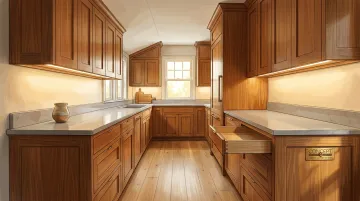
Consider a 1970s ranch home in Boulder County: galley kitchen, slightly angled back wall, 9-foot ceilings. Stock base cabinets won't run cleanly along that wall — the result is either a wide filler strip that looks like an afterthought or cabinets that stop short and leave a gap.
A custom build eliminates both problems. The cabinets are manufactured to the exact wall length and ceiling height, with no fillers, no gaps, no compromises.
If your home falls into this category, Concept 32 Custom Cabinet Studio works throughout Boulder County, the Denver metro, and the Northern Front Range. Their portfolio includes projects in Nederland — older mountain homes where non-standard dimensions are the norm — and Denver, where urban layouts carry their own architectural constraints. A free in-home consultation lets their designers assess your space before any manufacturing begins.
Conclusion
Stock and semi-custom cabinets fill a real need — they're the right call for rentals, standard layouts, and tight budgets. But for homeowners who want a kitchen that fits precisely, performs reliably, and holds its value, custom cabinetry is the stronger long-term investment.
Custom cabinets optimize how you move through your kitchen every day, eliminate the sizing compromises that come with stock options, and add real resale value to your home.
If you're a homeowner in Boulder County, Denver metro, or the Northern Front Range, Concept 32 Custom Cabinet Studio offers free in-home consultations to explore what fully custom cabinetry can do for your space. This is especially useful in older homes where stock sizing simply won't work. Call 303-682-4052 or stop by the Longmont showroom at 117 S Sunset St G to get started.
Frequently Asked Questions
What is the average price difference between custom and semi-custom cabinets?
Semi-custom cabinets typically run $100–$700 per linear foot, while custom cabinets start around $500 per linear foot and can exceed $1,200 for high-end configurations, according to Angi's cost research. The gap narrows quickly when semi-custom orders include multiple modifications and upgrades.
Are semi-custom cabinets worth the money?
For standard kitchens with moderate design goals, semi-custom offers good value. Homeowners with unique layouts or long-term quality goals often find full custom more worthwhile once semi-custom upcharges start stacking up.
Do custom cabinets increase home value?
Quality cabinetry consistently ranks among the kitchen features buyers notice most. Zillow Research found that homes featuring natural wood cabinetry and nature-inspired finishes can sell for up to 3.5% more — a notable advantage in Denver metro, where median home prices sit near $605,000.
Which cabinet style is best for a kitchen?
Shaker and flat-panel (modern) profiles remain consistently popular across most home styles. Custom cabinetry lets you execute any profile precisely, including two-tone combinations and specialty door configurations not available in stock catalogs.
How long do custom kitchen cabinets take to install?
Lead times vary by manufacturer. Examples from DirectCabinets' December 2025 data range from 6–9 weeks for standard custom finishes to 16 weeks for some lines. Locally manufactured cabinets — like those built by Concept 32 in Longmont — offer more direct communication and flexibility throughout the process.
What are the main disadvantages of stock cabinets?
Stock cabinets come with four consistent drawbacks: fixed sizing that leaves gaps or requires filler strips in most kitchens, a limited selection of styles and finishes, lower-grade materials (particleboard is common) that wear faster over time, and difficulty finding matching replacements years later if a unit needs repair.