The challenge isn't finding someone who claims to do custom work. It's knowing how to verify those claims before you sign a contract or hand over a deposit.
This guide covers the defining traits of a high-end custom cabinetry contractor, the key factors homeowners should evaluate before hiring, and the specific questions that protect your budget and vision throughout the process.
Key Takeaways
- High-end custom contractors build around your specific space — not standard cabinet sizes or pre-set configurations
- Construction specs (plywood boxes, dovetail drawers, hardware brand) reveal quality faster than any portfolio
- Ask directly about materials; a contractor who won't answer clearly signals a red flag
- Pricing transparency, written warranties, and a realistic timeline protect your investment
- Local, USA-made manufacturing with in-home consultation offers accountability, shorter lead times, and direct quality oversight that imported cabinet lines can't match
What Is a High-End Custom Cabinetry Contractor?
A high-end custom cabinetry contractor designs, builds, and installs cabinets tailored to the precise dimensions, materials, and functional needs of a specific home. This is distinct from the two more common alternatives:
| Cabinet Type | What It Means |
|---|---|
| Stock | Factory-made in fixed standard sizes; no modification |
| Semi-Custom | Limited adjustments to pre-set configurations; follows standard sizing rules |
| Custom | Built to exact dimensions, with full control over wood species, finish, hardware, and interior configuration |
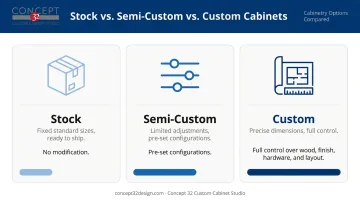
How Custom Differs from Semi-Custom and Stock
Truly custom cabinetry involves precise sizing for every single cabinet. You choose the wood species, finish, hardware, and interior layout — not from a pre-approved catalog, but from your actual vision.
This level of control matters most in spaces with non-standard dimensions, high-end appliances requiring precise integration, or whole-home projects where design coherence across kitchen, bathrooms, and closets is the goal. Custom costs more than stock or semi-custom — but it's the only option that delivers purpose-built storage, premium materials built to last, and a design that holds together room to room.
What Sets High-End Contractors Apart
High-end contractors stand apart from general cabinet dealers in ways that directly affect your final result:
- In-house design capabilities — detailed layout drawings or 3D visualization, not hand sketches
- Master-level craftspeople on staff — not subcontracted labor with variable standards
- Controlled manufacturing — built domestically (or locally) with clear quality oversight, not outsourced fabrication
Reputable custom contractors are transparent about where and how their cabinets are built, what materials are used, and how quality is controlled. A contractor who deflects these questions is one to walk away from.
Key Factors for Choosing a High-End Custom Cabinetry Contractor
Selecting the right contractor involves evaluating several interconnected factors. No single element should carry all the weight — quality, longevity, and your overall experience depend on how these factors work together.
Experience and Specialization in High-End Projects
Verify the contractor has direct experience with projects similar in scope and style to yours. A strong portfolio shows diversity — kitchens, bathrooms, closets, built-ins — while demonstrating precision joinery, custom sizing, and premium finishes throughout.
Ask specifically how many completed projects they have in your project type. Then ask to see before-and-after photos of real installed work. Inexperienced contractors often present renderings rather than actual completed installations, and that distinction matters when you're evaluating real craftsmanship.
Construction Quality Standards
When evaluating a contractor, look past the marketing and check for these specific construction indicators:
- All-plywood box construction — not particleboard or standard MDF
- Solid wood face frames on framed cabinet styles
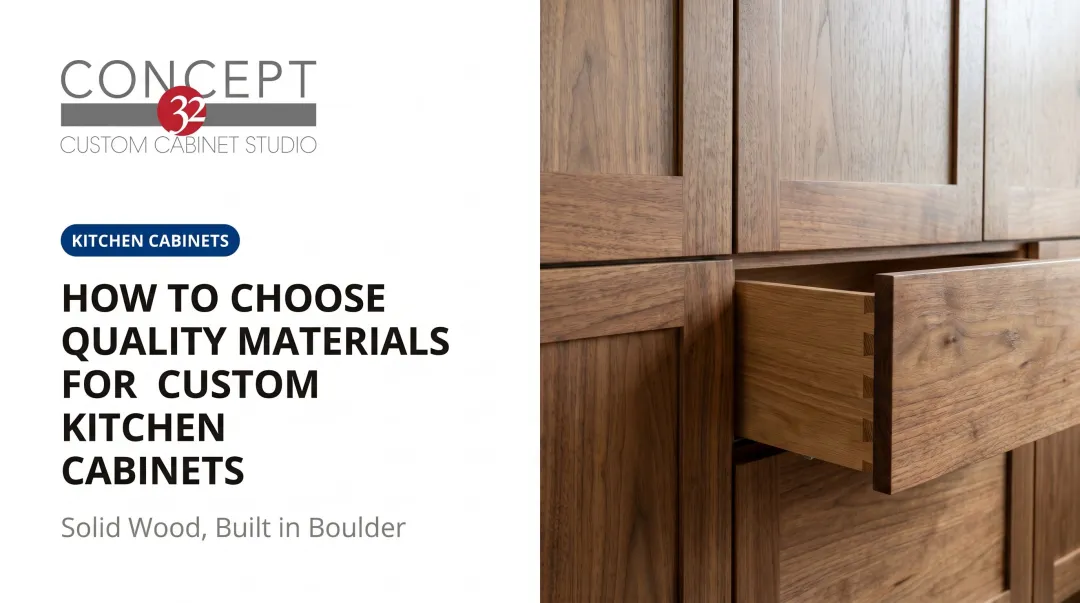
- Dovetail drawer joints — the recognized benchmark for drawer strength and craftsmanship
- Full-extension soft-close drawer hardware
- Premium hinges with integrated soft-close and multi-directional adjustment (Blum hardware meets this standard)
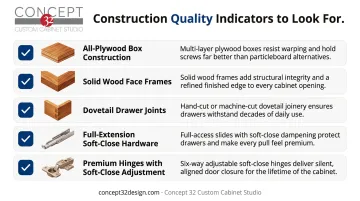
Ask contractors directly: Are your boxes plywood or particleboard? What drawer joint method is standard? What hardware brands do you use? A contractor unwilling to answer these questions specifically should not be building your cabinets.
Customization Capabilities and Design Flexibility
A truly high-end contractor accommodates non-standard dimensions and custom interior configurations without steering you toward limited pre-set options. Look for the ability to incorporate:
- Pull-out shelving, rollouts, and interior dividers
- Spice drawers and appliance garages
- Custom wine racks and beverage stations
- Aventos vertical lift hardware for ergonomic upper cabinet access
- Motion-activated and integrated LED lighting
Whole-home design capability — coordinating cabinetry across kitchen, bathrooms, closets, mudrooms, laundry, and home offices with consistent style and finish — is a premium service indicator. If you're planning a multi-room renovation, confirm upfront that the contractor has completed similar whole-home projects, not just standalone kitchens.
Credentials, Licensing, and Pricing Transparency
Legitimate custom contractors carry proper business licensing and general liability insurance. In Colorado, Boulder County requires a contractor license for work performed for compensation that requires a building permit, and the City of Longmont has its own licensing requirements for general contractors. Verify both before signing anything.
Professional affiliations such as NKBA (National Kitchen and Bath Association) or KCMA (Kitchen Cabinet Manufacturers Association) signal commitment to industry standards — though outstanding craftspeople sometimes operate without these designations. Cross-reference with verified reviews and project references regardless.
According to 2026 data from Angi, high-end custom cabinets range from $500 to over $1,500 per linear foot, with total project costs typically falling between $2,797 and $12,934. At that price range, verbal-only estimates leave too much room for scope creep and budget surprises — get everything in writing.
A reputable contractor's written proposal should specify:
- Material brands and wood species
- Finish type
- Hardware selections
- Payment schedule
- Project timeline
- Warranty terms
Strong custom cabinet warranties cover a minimum of 1–5 years on craftsmanship, with reputable manufacturers often offering lifetime warranties on construction. Ask specifically whether the warranty covers installation labor, not just the cabinet product itself.
Communication and Timeline Management
The contractor-client relationship on a custom cabinetry project can span several months. Research from Houzz Pro in 2025 found that once projects begin, 28% of homeowners cite understanding timeline changes as a top challenge, and 19% cite timely communication from professionals as a pain point.
High-end custom cabinets commonly require 8–14+ weeks from finalized design to installation, depending on complexity and contractor workload. Multiple custom manufacturers confirm this range. A contractor who sets realistic lead time expectations, communicates proactively, and has a structured process for client updates is far easier to work with through a project that long.
Evaluate responsiveness during the consultation phase. How quickly they respond before you hire them is a reliable predictor of how communication will work throughout production and installation.
Questions to Ask Before You Hire a Custom Cabinetry Contractor
Bring this checklist to your first consultation. The way a contractor responds tells you as much as the answers themselves — vague, defensive, or unprepared replies are red flags before a single cabinet is built.
"What materials do you use for cabinet boxes, door frames, and drawer construction?" Expect specifics: plywood boxes, named solid wood species, and dovetail or dowel joinery. "Quality materials" without detail is a non-answer.
"Where are your cabinets manufactured?" Local or USA-made production means tighter quality control and faster resolution if corrections are needed. Overseas fabrication makes defect resolution slower and harder to enforce.
"Can you show me completed installations similar to my project, or connect me with past clients?" Any contractor confident in their work will connect you with past clients. Ask for installed photos — not just renderings — of projects similar to yours in scope.
"What does your warranty cover and for how long?" Should cover both the cabinet product and installation labor. Ask what voids the warranty.
"What is your typical lead time, and what is your process if there are delays or defects?" How they answer this reveals how they handle problems, not just how they sell projects. Get the lead time in writing and build buffer into your renovation schedule.
"Do you offer in-home consultation and design drawings before production begins?" Skipping this step is how expensive mistakes happen. If a contractor moves to production without drawings you've reviewed and approved, that's a significant risk.
How Concept 32 Custom Cabinet Studio Can Help
For homeowners in Boulder County and the Northern Colorado Front Range, Concept 32 Custom Cabinet Studio offers a model that addresses each of the factors above directly.
All cabinetry is designed and manufactured locally in their Longmont, Colorado facility by master builders on staff — not shipped from a warehouse or assembled from prefabricated components. This in-house model gives clients direct quality oversight that imported or nationally distributed cabinet lines cannot match.
Designer Emily Vizzard works with homeowners from initial concept through installation, covering kitchens, bathrooms, closets, mudrooms, laundry rooms, home offices, and whole-home renovations — with whole-home coordination built into every project from the start.
Key construction and design features include:
- Solid wood cabinet construction
- Dovetail drawers
- Aventos vertical lift hardware
- Motion-activated and integrated LED lighting
- Custom wine racks and beverage stations
- Custom finish options including two-tone locally mixed paint, wood grain combinations, and zero-edge profiles for flat-panel styles
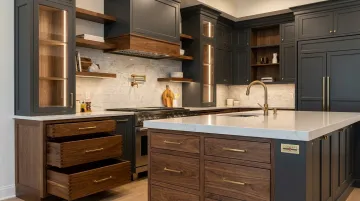
The studio serves Denver, Longmont, Fort Collins, Loveland, Broomfield, Westminster, Thornton, Brighton, Aurora, Greeley, Windsor, and surrounding communities. The first step is a free in-home consultation — contact the studio at 303-682-4052 or visit the showroom at 117 S Sunset St G, Longmont, CO 80501.
Conclusion
The right high-end custom cabinetry contractor is defined by construction standards, design capability, clear communication, and accountability — not marketing reach. Finding a studio whose approach aligns with your project and long-term expectations is what separates a cabinet job you'll love for decades from one you'll regret after a year.
Ask hard questions about materials and manufacturing. Verify credentials and licensing, and get everything in writing. Choose a contractor who builds locally — where quality control stays close, communication stays clear, and accountability doesn't disappear the moment your order ships.
Homeowners in Boulder County and the Northern Front Range can start the process with a free in-home consultation with Concept 32 Custom Cabinet Studio to explore what locally manufactured, USA-made, fully custom cabinetry can look like in their home.
Frequently Asked Questions
What is the average cost for high-end kitchen cabinets?
According to 2026 data from Angi, high-end custom kitchen cabinets range from $500 to over $1,500 per linear foot, with total project costs typically between $2,797 and $12,934. Always request a detailed written quote — per-linear-foot estimates don't capture hardware, finishes, or interior configuration costs.
How do I spot high-quality cabinetry?
Look for plywood or solid wood box construction (not particleboard), dovetail drawer joints, soft-close full-extension hardware, tight door alignment with no visible gaps, and a smooth durable finish without brush marks or uneven sheen. These physical indicators tell you more than any marketing claim.
What is the 1/3 rule for cabinets?
The 1/3 rule is a general budgeting guideline suggesting cabinetry represent roughly one-third of a total kitchen renovation budget. For high-end custom projects, that proportion often shifts — NKBA has noted that premium custom cabinetry can consume a larger share depending on material upgrades and scope.
What questions should I ask a custom cabinetry contractor before hiring?
Prioritize these: What materials are used for boxes and drawers (plywood vs. particleboard, wood species)? Where are the cabinets manufactured? What does the warranty cover and for how long? What is the typical lead time? Do you offer in-home consultation and design drawings before production begins?
What is the difference between custom, semi-custom, and stock cabinets?
Stock cabinets come in fixed standard sizes with no modification. Semi-custom allows limited adjustments to pre-set configurations. Fully custom cabinets are built to precise dimensions sized and configured for each homeowner's space — with full control over material, finish, and interior layout.
How long does custom cabinetry typically take from order to installation?
High-end custom cabinetry generally requires 8–14 weeks or more from finalized design to installation, depending on project complexity, material availability, and contractor workload. Confirm lead times in writing and build buffer time into your renovation schedule to avoid delays with other trades.