Both options can work. The real question is which one actually solves your problem long-term, and that depends on factors most comparison guides skip past entirely.
This article breaks down custom garage cabinets versus modular storage across the factors that actually matter: cost, fit, materials, installation, and what happens to your home's value when you go to sell.
Key Takeaways
- Custom garage cabinets are built to your exact dimensions and cost $2,000–$15,000+; modular systems run $300–$5,000+ depending on brand and configuration
- Custom cabinets eliminate dead space in non-standard garages; modular units leave gaps in awkward layouts
- Premium modular brands offer lifetime warranties, but construction quality varies widely — budget options frequently warp or rust within a few years
- Custom cabinetry is a permanent fixture that contributes to resale value; most modular units get removed at sale
- Modular suits renters and tight timelines; custom is the better investment for long-term homeowners
Custom vs. Modular Garage Storage: Quick Comparison
| Factor | Custom Cabinets | Modular Systems |
|---|---|---|
| Cost | $2,000–$15,000+ installed | $300–$5,300+ (materials only) |
| Design Fit | Built to exact dimensions | Standard sizes; gaps likely |
| Materials | Solid wood, premium composites | Steel or particleboard; quality varies |
| Installation Time | Several weeks (design + build + install) | Same day to 1–2 days |
| Durability | Decades with proper care | Years to a decade (brand-dependent) |
| Home Value | Adds resale appeal as a fixture | Typically removed before sale |
| Best For | Long-term homeowners, complex spaces | Renters, tight budgets, quick fixes |
Cost in Detail
According to Angi's 2026 cost data, custom garage cabinetry typically runs $2,500–$10,000 for a mixed system of tall cabinets, upper and lower cabinetry, shelving, drawers, and a workbench — with per-cabinet costs ranging from $505–$2,152 installed. Premium configurations with extensive storage and specialty features can exceed $15,000.
Modular systems span a wide range depending on quality tier:
- Budget single cabinet (Husky, Gladiator RTA): $307–$550
- Mid-range 6–9 piece sets (NewAge Bold Series): $1,380–$1,800
- Premium 8–12 piece sets (NewAge Pro Series, 18-gauge): $3,700–$5,300
The gap narrows at the premium modular end. Even so, custom cabinetry offers something standard steel systems can't match: dimensions built specifically for your walls, corners, and ceiling height.
What Are Custom Garage Cabinets?
Custom garage cabinets are designed, manufactured, and installed specifically for one garage — built around its actual dimensions, structural constraints, and storage demands rather than adapted from a standard catalog.
That distinction shows up immediately in garages with non-standard layouts: sloped ceilings, water heaters, breaker boxes, or walls that aren't square. A custom solution accounts for every constraint. Modular systems work around them, often leaving awkward gaps or forced compromises.
What the Build Process Looks Like
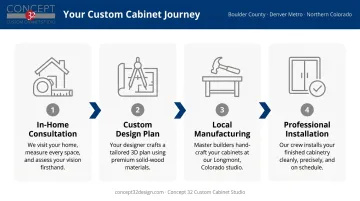
For a local studio like Concept 32 Custom Cabinet Studio in Longmont, Colorado, a garage project follows a structured sequence:
- In-home consultation — a designer visits to assess the space, understand how you use the garage, and identify storage priorities across tools, gear, automotive, and seasonal items
- Custom design plan — the layout is built around your specific wall runs, obstacles, and functional needs (not a template)
- Local manufacturing — cabinets are built in-house at the Longmont facility by master builders, with heavy-capacity construction sized for tools and equipment
- Professional installation — components arrive cut to size, install flush to walls, and finish level on any floor surface
Because everything is manufactured locally, there's no middleman markup — and the design can be adjusted right up until production begins.
What You Can Configure
Custom garage cabinetry covers a wide range of configurations:
- Base cabinets and upper wall cabinets sized to your ceiling height
- Tall lockers for bikes, skis, or long-handled tools
- Integrated workbenches for automotive or hobby use
- Pull-out drawers, deep storage drawers, and rollout shelving
- Motion lighting, slatwall panels, and specialty inserts
For homeowners in Colorado's Front Range — where a single garage might need to store ski equipment, hiking gear, power tools, and a mountain bike — that range of options translates directly into a garage that works without compromise.
When Custom Makes Sense
- You're doing a full garage renovation or whole-home upgrade
- Your garage serves multiple purposes (workshop, gear storage, vehicle maintenance)
- The space has non-standard dimensions or structural obstacles
- You want the garage to contribute to resale value as a finished, functional room
What Are Modular Garage Storage Systems?
Modular systems are pre-manufactured storage units — steel or particleboard cabinets, freestanding shelving, slatwall panels, or overhead racks — sold in standard sizes and assembled on-site. Most are available same-day at Home Depot or Lowe's, which is a genuine advantage when you need the garage organized by the weekend.
Quality Varies Considerably
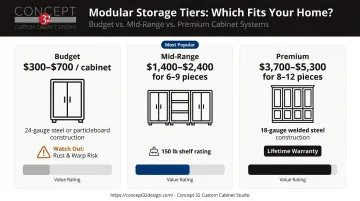
Not all modular systems are created equal. The market breaks into three tiers:
| Tier | Price Range | What You Get | Watch Out For |
|---|---|---|---|
| Budget | $300–$700 per cabinet | 24-gauge steel or particleboard, basic powder coat | Warps in humidity; rusts in moisture-prone garages |
| Mid-range | $1,400–$2,400 for 6–9 pieces | NewAge Bold, Gladiator RTA, Husky heavy-duty; 150 lb shelf ratings | Fine for general storage, not built for heavy-duty use |
| Premium | $3,700–$5,300 for 8–12 pieces | 18-gauge fully welded steel (NewAge Pro Series), Limited Lifetime Warranty | Highest upfront cost in the modular category |
The "best bang for your buck" marketing common in this category can mislead buyers. A $400 cabinet that warps within three years costs you twice — once to buy it, once to replace it.
Key Limitations
- Standard module widths (typically 28", 36", or 48") leave gaps on walls that aren't divisible by those increments
- Fixed heights may not reach your ceiling, wasting vertical storage
- Configurations are locked to what's in the product line — you can't add a built-in workbench or wrap a cabinet around a support column
When Modular Makes Sense
- You're renting or plan to move within a few years
- You need storage organized quickly on a limited budget
- Your garage is a straightforward rectangular layout with standard walls
- You want a temporary solution before a future renovation
Which Is Better? Making the Right Call for Your Situation
Neither option is universally better. Five factors should drive the decision:
- How long you plan to stay in the home — custom is a long-term investment; modular makes more sense if you might move
- Your garage's layout — non-standard dimensions push strongly toward custom
- How you use the garage day-to-day — a multi-use workshop space benefits far more from custom than a garage used only for storage
- Your budget — custom requires a larger upfront commitment, though the long-term cost equation is closer than it appears
- Whether resale value matters — professionally installed cabinetry is considered a permanent fixture; modular units are personal property
The Long-Term Cost Equation
Warranty data tells part of the story. Premium custom and premium modular brands both advertise lifetime warranties — but warranties cover defects, not everyday wear. Budget modular units that cost $1,500 today and need replacing in five years cost more over a decade than a $6,000 custom system still functional twenty years later. Run the numbers before you decide — the gap often narrows significantly.
A Real-World Scenario
Consider a homeowner in Boulder County with a two-car garage that doubles as a ski prep area, tool storage, and overflow for seasonal gear. The garage has a sloped ceiling on one wall, a water heater tucked into a corner, and walls that don't line up symmetrically.
A standard modular set leaves gaps around the water heater, can't accommodate the slope, and runs out of configuration options before the walls do.
A custom solution — like what Concept 32 designs and builds locally in Longmont — handles each of those constraints directly: cabinets wrap the water heater, tall purpose-built units follow the ceiling slope, and ski gear, tools, and automotive supplies each get dedicated space in a system built for that specific garage.
That kind of fit doesn't happen by accident — it comes from measuring the actual space first. Concept 32 offers a free in-home consultation where a designer visits your garage, takes field measurements, and builds a plan around what you actually need. Reach them at 303-682-4052 or schedule online.
Conclusion
Custom garage cabinets and modular storage systems serve different homeowners at different stages. Custom makes sense when permanence, precise fit, and long-term quality are the priority — especially in complex spaces or when the garage is functioning as a true room in the home. Modular works when speed and budget flexibility matter more than longevity.
The costlier mistake is buying the wrong one. A budget modular system in a garage that needed custom cabinets means doing the project twice — spending more in the long run than a single well-designed solution would have cost. For homeowners in Boulder County and the Northern Front Range ready to get it right the first time, Concept 32 offers a free in-home consultation: a designer in your space, measuring tape in hand, ready to map out a real plan.
Frequently Asked Questions
What is the difference between custom garage cabinets and modular storage systems?
Custom cabinets are designed and built specifically for your garage's exact dimensions and storage needs, then professionally installed. Modular systems are pre-manufactured in standard sizes and assembled on-site. The key differences are fit, material quality, and how long each solution lasts.
How much do custom garage cabinets cost compared to modular systems?
Custom garage cabinet projects typically run $2,500–$10,000 for a full mixed system, with premium configurations exceeding $15,000. Mid-range modular sets (6–9 pieces) run $1,380–$2,400; premium 18-gauge modular sets reach $3,700–$5,300. Both costs vary based on garage size, materials, and features selected.
Do custom garage cabinets add home value?
Professionally installed custom cabinetry counts as a permanent fixture, which increases resale appeal and buyer confidence. Modular storage units are personal property that most homeowners take with them or remove before listing.
How long does it take to install custom garage cabinets?
Custom cabinets involve a consultation, design phase, local manufacturing, and professional installation, which typically spans several weeks from first appointment to finished install. Modular systems can be purchased same-day and assembled within one to two days.
Can modular garage storage be upgraded to custom cabinets later?
Yes. Many homeowners start with modular systems and transition to custom cabinets during a renovation. The two approaches aren't mutually exclusive — a custom designer can assess your current setup and build a solution that replaces or works alongside what you already have.
Are custom garage cabinets worth it for a small garage?
Custom cabinets are actually most valuable in smaller garages. Standard modular units in fixed sizes leave gaps and underuse corners that a custom solution fills precisely, maximizing every available inch where wasted square footage hurts most.