
The honest answer? Kitchen remodel costs in Denver vary enormously depending on scope, materials, and whether you're changing the layout. A cosmetic refresh looks nothing like a full custom gut renovation — and neither should their price tags.
This guide breaks down realistic local pricing tiers, the factors that move costs up or down, and how to build a budget that actually fits your goals.
Key Takeaways
- Denver kitchen remodels range from roughly $25,000 (cosmetic refresh) to $150,000+ (full custom renovation)
- Cabinetry is the single largest line item, typically consuming 29–40% of the total budget
- Keeping the existing layout is the most effective way to control costs
- Denver permits are required for electrical, plumbing, gas, or structural changes
- Budget a 10–20% contingency — older Denver homes frequently reveal hidden conditions during demolition
How Much Does a Kitchen Remodel Cost in Denver?
Denver kitchen remodel pricing runs higher than many national benchmarks. Local contractor guides cite a range of $190–$375 per square foot for Denver-area projects, compared to HomeAdvisor's national range of $75–$250 per square foot. Higher local labor rates, material availability, and permitting costs all contribute to that gap.
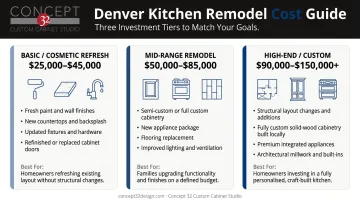
What you'll spend depends heavily on scope. Here's how Denver projects break down across three tiers:
Basic / Cosmetic Refresh: $25,000–$45,000
This tier covers visible updates without touching the bones of the kitchen:
- Cabinet repainting or refacing
- New countertops and backsplash
- Updated fixtures and lighting
- No layout changes or structural work
Best for homeowners whose kitchen functions well but needs a visual refresh, or those working within a tighter budget.
Note that purely cosmetic refreshes at the lower end of this range are only achievable when plumbing, electrical, and layout all stay completely untouched. Any trade work expands the scope and the cost.
Mid-Range Remodel: $50,000–$85,000
This is what most Denver homeowners mean when they say they want a "real remodel":
- New semi-custom cabinetry
- Updated appliances and new flooring
- Countertop replacement (typically quartz or granite)
- Minor layout adjustments without structural changes
Best for homeowners ready to replace core elements and improve daily functionality. For reference, the 2025 Cost vs. Value Mountain region report puts a major midrange kitchen remodel at $81,538 in job cost, which lands squarely in this range.
High-End / Full Custom Remodel: $90,000–$150,000+
Full custom projects involve structural work and premium finishes throughout:
- Structural changes: wall removal, layout redesign
- Custom cabinetry and premium countertop surfaces
- Professional-grade appliances
- Custom lighting, islands with seating, built-in wine storage
Best for homeowners in higher-value Denver neighborhoods, whole-home renovation projects, or buyers seeking maximum resale return. The 2025 Cost vs. Value Mountain region data shows major upscale kitchen projects already exceeding $159,000. For fully custom builds, treat $150,000 as a starting point, not a ceiling.
Key Factors That Affect Kitchen Remodel Costs in Denver
The final price of any Denver kitchen remodel is shaped by several overlapping variables. Understanding each one helps homeowners make trade-offs that protect the budget without sacrificing the outcome.
Layout Changes and Structural Work
Keeping appliances, plumbing, and the range in their existing locations is the single most effective way to control cost. Moving the sink, opening a wall, or adding an island with plumbing introduces structural, permit, and trade labor expenses that compound quickly:
- Wall removal: $300–$2,000 for a non-load-bearing wall (national proxy)
- Plumbing relocation: $4,000–$7,000 for kitchen plumbing moves or island sink setup
- Dedicated circuit installation: $250–$900 per circuit in the Denver area
Older Denver homes add another layer of risk. About 50.9% of Denver's housing units were built before 1980, according to ACS 2024 data — and once walls open, electrical panels, ventilation systems, and subfloors frequently need attention that wasn't in the original scope.
Cabinetry: The Largest Single Line Item
Cabinets typically account for 29–40% of the total kitchen remodel budget, making them the design anchor and the most consequential purchasing decision, with three tiers to consider:
| Cabinet Type | Characteristics | Approximate Range |
|---|---|---|
| Stock | Standard sizes, shortest lead times | $75–$400/linear ft |
| Semi-custom | More design flexibility, moderate premium | $150–$650+/linear ft |
| Custom | Full dimensional freedom, specialty storage | $500–$1,500+/linear ft |
For Denver homeowners, locally manufactured custom cabinets — like those built by Concept 32 Custom Cabinet Studio in Longmont — offer real advantages over nationally shipped options:
- Eliminates middleman markups common with national suppliers
- Allows millimeter-level precision fitting for non-standard kitchen layouts
- Avoids the 8–16 week lead times typical of national cabinet brands
- Semi-custom options available for homeowners who want quality and personalization without a fully bespoke build
Countertops, Flooring, and Surfaces
Material grade drives both budget and longevity. A rough hierarchy:
- Budget tier: Laminate countertops ($20–$80/sq ft installed), vinyl plank flooring
- Mid tier: Quartz ($59–$130/sq ft installed), engineered hardwood ($7–$20/sq ft installed)
- Premium tier: Natural stone, marble ($15–$190/sq ft), site-finished hardwood
One detail homeowners often overlook: fabrication complexity adds cost beyond material price alone. Waterfall edges, multiple seams, and custom cutouts all increase labor regardless of which material you choose.
Permits, Hidden Conditions, and Contingency
Denver requires permits whenever electrical, plumbing, gas, or structural work is involved. Like-for-like replacements of cabinets, countertops, and fixtures generally don't require permits — but most meaningful remodels will trigger at least one permit category.
Denver permit fee estimates (building + standard plan review):
- $25,000 project valuation: ~$329
- $45,000 project valuation: ~$570
- $85,000 project valuation: ~$998
- $150,000 project valuation: ~$1,575
Budget 10–20% contingency beyond your project cost. This isn't optional padding — it's a practical necessity in a city where half the housing stock predates 1980.
Denver Kitchen Remodel Cost Breakdown by Component
Understanding how a budget splits across components helps homeowners prioritize wisely and compare contractor proposals on equal footing.
Typical distribution for a Denver kitchen remodel:
- Cabinets and hardware: 29–40%
- Labor and installation: 17–20%
- Appliances and ventilation: 11–14%
- Countertops: 7–10%
- Flooring: 5–7%
- Plumbing: 5–6%
- Electrical and lighting: ~5%
- Backsplash: 4–5%
- Permits and miscellaneous: 4–5%
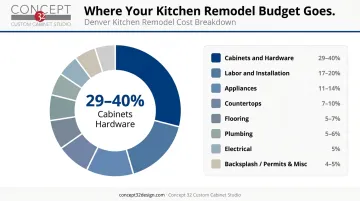
Here's what each major line item actually means for your project:
- Cabinets set the visual tone and functional backbone of the entire kitchen. Construction quality — solid wood vs. plywood vs. MDF, dovetail joints vs. stapled boxes — determines both durability and daily usability for decades.
- Labor is the variable most tied to scope and schedule. Layout changes, structural work, and older-home conditions can push costs 20–30% above initial estimates in Denver's older housing stock.
- Appliances are the easiest component to phase. Buying a new range now and upgrading the refrigerator in two years is a practical strategy for homeowners managing a tight budget.
- Countertops and flooring deliver strong resale return relative to their cost — and they're among the first things buyers notice on a tour.
When allocating your budget, cabinets and labor together typically consume 45–60% of total spend. Those two line items are where decisions about scope and quality have the most leverage over your final number.
Budget vs. High-End Kitchen Remodel: What's the Real Difference?
Both tiers can produce a functional, attractive kitchen. The differences show up in durability, customization, and long-term maintenance.
| Budget Remodel | High-End / Custom Remodel | |
|---|---|---|
| Cabinets | Stock sizing, MDF doors, stapled drawers | Custom dimensions, solid wood, dovetail joinery |
| Countertops | Laminate or basic granite | Quartz, quartzite, or natural stone with custom edge profiles |
| Hardware | Basic hinges and drawer slides | Premium systems like Aventos vertical lifts, soft-close undermount slides |
| Storage | Fixed shelving, standard layout | Rollouts, dividers, motion lighting, custom wine racks |
| Fit | Filler strips to accommodate stock sizing | Built to the exact dimensions of the space |
The long-term value gap is real. The 2025 Cost vs. Value Mountain region data shows a minor midrange kitchen remodel returning roughly 110% of costs at resale — meaning small, well-executed refreshes frequently pay for themselves. Major midrange projects recoup about 49%, and upscale builds around 35%. In Denver's competitive housing market, a thoughtfully executed mid-range remodel in the right neighborhood often outperforms a premium custom build from a pure ROI standpoint.
That said, homeowners planning to stay in their homes for 10+ years should weigh daily function and material longevity heavily — not just resale math.
For long-term owners, features like dovetail drawer construction, Aventos lifts, and motion lighting aren't about aesthetics — they're durability decisions that extend a kitchen's functional lifespan by decades compared to budget-tier alternatives.
How to Budget Smart for Your Denver Kitchen Remodel
Smart budgeting starts with decisions, not dollars. Choosing your layout approach — like-for-like vs. full redesign — before finalizing any numbers sets the entire cost trajectory.
Prioritize these elements first:
- Cabinet quality (you interact with them hundreds of times per day)
- Countertop material (durability and wear resistance matter more than aesthetics alone)
- Layout efficiency (a well-designed existing layout beats a mediocre new one)
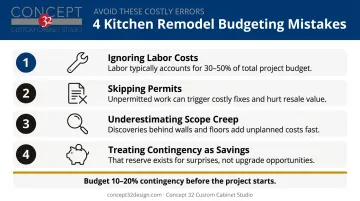
Avoid these common budgeting mistakes:
- Focusing only on material sticker prices — labor and installation typically add 50–100% to material costs
- Skipping permits to save money — unpermitted work creates disclosure obligations and liability at resale in Colorado
- Underestimating scope creep — budget for what demolition might reveal, not just what you can see today
- Treating the contingency as savings — set aside 10–20% before the project starts and don't touch it unless you need it
Getting cabinet selections finalized early — before permits are pulled or demolition begins — is one of the most practical ways to protect both timeline and budget. Cabinet dimensions affect countertop measurements, appliance panel requirements, and layout dimensions. Locking in those decisions upstream prevents a cascade of change orders downstream.
Concept 32 Custom Cabinet Studio offers free in-home consultations for Denver-area homeowners, covering everything from solid wood construction and dovetail drawers to custom storage configurations and motion lighting. Because they manufacture locally in Longmont, they can give you accurate lead times and specifications tied to your actual project.
Frequently Asked Questions
What is the average kitchen remodel cost in Denver?
Most Denver kitchen remodels fall between $25,000 on the low end (cosmetic refresh) and $85,000 for a mid-range renovation, with custom or high-end projects exceeding $100,000–$150,000. Denver-specific labor rates and permit costs push totals above many national averages, so national figures often underrepresent what homeowners here actually spend.
What is the 30% rule in remodeling?
The 30% rule advises against spending more than 30% of your home's current market value on a kitchen remodel, since costs above that threshold are difficult to recoup at resale. In Denver — where Zillow reports an average home value around $539,712 — treat it as a guideline, not a hard ceiling, and weigh it against your neighborhood's comps.
Is $50,000 enough for a kitchen remodel in Denver?
$50,000 can support a functional mid-range remodel in Denver if the existing layout is preserved and material selections are made carefully. That budget leaves little room for structural changes, custom cabinetry, or premium appliances — but a well-planned like-for-like remodel at this price point is achievable.
Do kitchen remodels require permits in Denver?
Permits are required in Denver whenever electrical, plumbing, gas, or structural changes are involved. Purely cosmetic work — painting cabinets, swapping hardware, replacing like-for-like fixtures — typically does not require permits. Most full remodels will trigger at least one permit requirement.
What part of a kitchen remodel costs the most?
Cabinetry is typically the single largest cost category, often representing 29–40% of the total remodel budget. Labor is the next biggest variable, especially when layout changes are involved.
How long does a kitchen remodel take in Denver?
A cosmetic refresh typically takes 2–4 weeks, while a full mid-range or custom remodel runs 8–16 weeks. Custom cabinetry lead times — often 6–12 weeks — are usually the longest single factor in the schedule.