Introduction
When most homeowners start planning a kitchen renovation, they fixate on cabinet door styles, paint colors, and hardware finishes. Those details matter, but they're cosmetic. The real factor in whether your cabinets hold up for 15 years or 50 comes down to what they're actually made of.
Cabinetry represents roughly 29% of the total kitchen remodel budget — the single largest line item in any renovation. Material selection is where that investment either pays off long-term or falls short.
In 2026, Colorado homeowners are navigating a meaningful shift: natural wood grain is surging in popularity, eco-conscious sourcing is becoming standard expectation, and the conversation around box construction materials has finally caught up.
This guide breaks down the five materials that matter most for custom kitchen cabinets (solid hardwood, plywood, MDF, thermofoil/acrylic, and bamboo), explaining what each does well, where it falls short, and which applications it actually belongs in.
Key Takeaways
- Solid hardwood is the benchmark for face frames, doors, and dovetail drawer boxes — refinishable, long-lasting, and resurgent in 2026.
- Plywood box construction is the single most impactful quality decision in any custom cabinet build — prioritize it over everything else.
- MDF excels specifically as a painted door substrate; it does not belong in structural box construction.
- Thermofoil and acrylic suit contemporary kitchens well — avoid placement near high-heat zones.
- Bamboo and FSC-certified woods deliver genuine durability and environmental credibility in equal measure.
Why Material Choice Defines Your Custom Kitchen Cabinets
With custom cabinets, every material decision is made intentionally — nothing defaults to whatever the manufacturer had in stock. The combination of box material, face frame construction, door substrate, and finish determines structural integrity, moisture resistance, finish longevity, and how reliably cabinets hold hardware after years of daily use.
For Colorado homeowners, there's an additional layer of complexity that most national cabinet guides overlook.
Colorado's Dry Climate and Wood Performance
Colorado's low humidity creates real, measurable stress on wood-based materials. At indoor relative humidity levels of 20–35% — typical during Front Range winters — wood reaches an equilibrium moisture content of just 4.5% to 6.9%, according to the USDA Forest Products Laboratory. The recommended range for interior woodwork is 6%–11%.
The consequence is visible over time:
- Paint films stay rigid while wood shifts underneath, producing hairline "witness cracks" at joints
- Doors warp as panels expand and contract unevenly
- Joints loosen and fail ahead of schedule
This isn't a reason to avoid wood — it's a reason to work with a builder who understands Colorado-specific acclimation, species selection, and finish sealing. The ideal indoor humidity range for wood cabinets sits between 35% and 50% RH; maintaining that range sharply reduces movement-related damage over time.
Each material covered below is evaluated against this climate reality — not just standard performance benchmarks.
The Best Materials for Custom Kitchen Cabinets in 2026
These materials are assessed on five criteria — not marketing claims:
- Durability: Long-term structural and surface performance
- Workability: How well the material supports precision construction
- Aesthetic range: Finish, texture, and style flexibility
- Environmental impact: Certifications, emissions, and sourcing
- Real-world performance: How each material holds up in Colorado's climate
Solid Hardwood
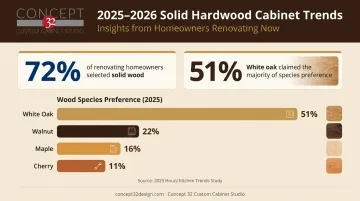
Solid hardwood — maple, white oak, cherry, walnut — has been the benchmark for premium custom cabinetry for decades. In 2026, it's not just holding that position; it's gaining ground. According to the 2025 Houzz Kitchen Trends Study, 72% of renovating homeowners selected solid wood as their primary cabinet material, with wood grain finishes surpassing painted cabinets as the dominant trend — white oak alone claimed 51% of species preference among design professionals.
Why it stands out:
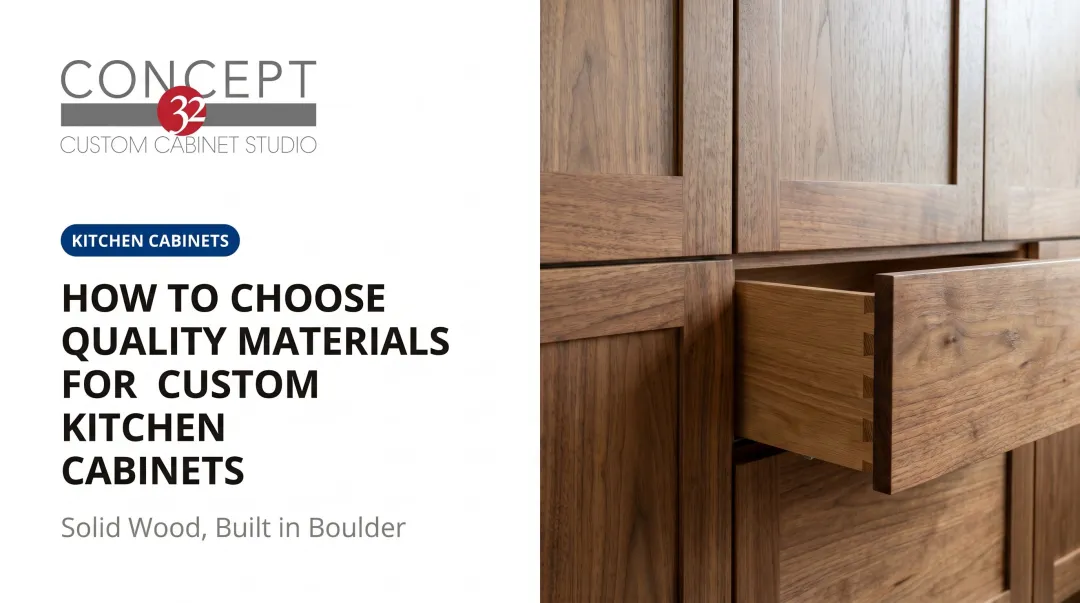
Solid hardwood provides structural integrity that engineered alternatives can't replicate for visible components. Dovetail joint construction — the hallmark of high-end drawer boxes — is only achievable in solid wood. It can be refinished multiple times, meaning a well-built set of solid wood cabinets can be updated stylistically without replacement, making it the most cost-effective option across a 30-year horizon.
Concept 32 Custom Cabinet Studio builds custom cabinets using solid wood construction and dovetail drawers, manufactured locally in Longmont by master builders. That local production matters in Colorado — it means materials can be acclimated and finished within the same climate zone where they'll ultimately live.
| Attribute | Details |
|---|---|
| Best For | Face frames, door panels, drawer boxes, exposed surfaces in transitional, traditional, or natural-aesthetic kitchens |
| Durability | 25–50+ years with proper care; refinishable multiple times; ages with character |
| Key Considerations | Higher upfront cost; requires proper acclimation and sealing in Colorado's low-humidity environment |
Plywood (Cabinet Box Construction)
Plywood is the industry standard for cabinet carcass construction — and the single most impactful quality decision a homeowner can make, at any price point. Made from cross-laminated wood veneers, it outperforms particleboard and lower-grade composites across every metric that matters for cabinet longevity.
Why it stands out:
- Holds screws and hinges reliably across decades of use
- Resists moisture exposure from dishwashers and under-sink plumbing without swelling
- Doesn't sag under heavy countertop loads the way particleboard does
- Resists racking (the gradual leaning or twisting of cabinet boxes under load)
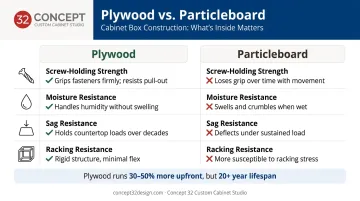
Plywood costs 30–50% more than particleboard upfront. That premium is consistently offset by reduced replacement risk — plywood boxes routinely last 20+ years; particleboard often needs structural intervention much sooner.
When evaluating custom cabinet quotes, ask specifically whether box construction uses ¾" plywood sides and at least ½" plywood backs. Verify this isn't veneered MDF composite being marketed as plywood — those are meaningfully different products.
| Attribute | Details |
|---|---|
| Best For | All cabinet box/carcass construction — base cabinets, uppers, pantry units, island frames |
| Durability | Very high screw-holding strength; moisture-resistant; strong long-term structural performance |
| Key Considerations | Heavier than MDF alternatives; confirm ¾" thickness for sides and ½" for backs |
MDF (Medium-Density Fiberboard)
MDF is an engineered wood product made from fine fibers bonded under pressure with resin. It has a specific, well-established role in custom cabinetry — and an equally specific list of applications where it doesn't belong.
Why it stands out for painted doors:
MDF accepts paint with near-perfect uniformity. No wood grain telegraphs through the finish. In Colorado's dry climate, this matters: solid wood doors expand and contract with humidity swings, producing witness cracks at joints.
MDF is dimensionally stable in temperature-controlled environments, making it significantly less prone to that cracking. Many premium cabinet manufacturers use it for painted door faces or center panels within five-piece door construction — precisely for this reason.
The critical limitation: MDF is not moisture-tolerant. Exposed edges swell when wet and don't recover. It has no place in box/carcass construction, particularly in moisture-prone zones near sinks or dishwashers.
One more thing to verify: formaldehyde emissions. CARB Phase 2 limits MDF to 0.11 ppm — always confirm CARB Phase 2 or EPA TSCA Title VI compliance on any composite panel product used in kitchen cabinetry.
| Attribute | Details |
|---|---|
| Best For | Painted cabinet door faces, interior panels, decorative trim elements |
| Durability | Stable, smooth paint surface; highly susceptible to water damage and edge swelling |
| Key Considerations | Never use in box construction; specify low-VOC, CARB Phase 2-compliant product |
Thermofoil and High-Gloss Acrylic
Thermofoil wraps an MDF substrate in vinyl film using heat and pressure. High-gloss acrylic panels — a premium step up — deliver a glass-like reflective surface that suits the 2026 trend toward sleek, handleless, slab-door contemporary kitchens. The NKBA/KBIS 2026 Kitchen Trends Report identifies flat slab cabinet door style as a growing trend among 69% of industry respondents.
Why they work for the right kitchen:
Both options offer genuine moisture resistance, straightforward cleaning, and contemporary aesthetics. Acrylic supports bold color directions — deep navy, matte black, emerald — with non-porous surfaces that resist fingerprints better than painted wood. Neither requires refinishing.
The trade-offs are real:
- Thermofoil adhesive softens at sustained temperatures above 150°F — causing edge peeling near ovens, ranges, and dishwasher steam vents. Heat-shield strips can reduce surface temps by ~30°F and cut adhesive failure risk by over 60%.
- Acrylic scratches can be permanent without professional buffing.
- Neither is refinishable — budget for full replacement rather than restoration when these surfaces reach end of life.
| Attribute | Details |
|---|---|
| Best For | Contemporary and minimalist kitchens; homeowners prioritizing low maintenance and bold, uniform color |
| Durability | Moisture-resistant; acrylic resists most scratches; thermofoil can peel near heat sources |
| Key Considerations | Thermofoil placement near cooktops requires careful planning; acrylic carries a significant cost premium |
Bamboo and Eco-Friendly Wood Alternatives
Bamboo achieves Janka hardness ratings that outpace most traditional hardwoods — more on that below. It's a grass, not a wood species, but that distinction rarely matters to the homeowner whose cabinet doors are still pristine after 20 years. FSC-certified hardwoods and reclaimed wood are also increasingly specified in eco-conscious custom builds, driven by a measurable shift in consumer priorities: 49% of Americans reported purchasing an environmentally friendly product in March 2025, up from 43% just seven months earlier.
Why bamboo holds up:
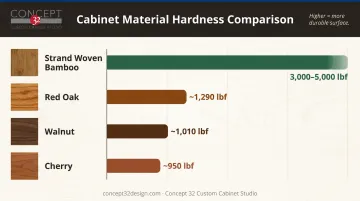
Strand woven bamboo achieves Janka hardness ratings of 3,000–5,000 lbf — far exceeding red oak (~1,290 lbf), walnut (~1,010 lbf), and cherry (~950 lbf). It handles moisture well and offers a clean aesthetic that works in modern and transitional kitchen styles alike.
In Colorado's sustainability-focused markets — particularly across Boulder County, Broomfield, and Fort Collins — eco-friendly material choices align naturally with homeowner values. Pairing these materials with low-VOC finishes also supports healthier indoor air quality, a meaningful consideration in homes where kitchens see daily family use.
FSC-certified wood is recognized by over 150 U.S. building standards and contributes to LEED certification credits — relevant for homeowners pursuing green building recognition on renovation projects.
| Attribute | Details |
|---|---|
| Best For | Eco-conscious builds; contemporary to transitional kitchen styles; door panels and face frame applications |
| Durability | Bamboo tests harder than most hardwoods; reclaimed wood durability varies by species and source |
| Key Considerations | Verify FSC certification; availability for fully custom builds may require discussion with your cabinet maker |
How to Choose the Right Cabinet Material for Your Kitchen
Material selection comes down to three practical factors:
- Kitchen usage patterns — Which zones face moisture (sink, dishwasher, under-sink plumbing) versus dry storage only?
- Aesthetic priorities — Painted finish, stained natural wood, or contemporary uniform surface?
- Long-term budget thinking — Upfront cost versus refinishing and replacement costs across 15–30 years.
Most homeowners nail these three criteria — then overlook the one factor that matters most.
The Most Common Mistake
Homeowners spend hours choosing door profiles and hardware finishes while giving almost no attention to box construction material — the decision that actually determines whether cabinets last a decade or three. All-plywood box construction is the single most impactful quality upgrade available at any price point. It's not visible, and it's rarely glamorous, but it outweighs almost every other choice you'll make.
Colorado-Specific Considerations
In Colorado's dry, high-altitude environment, wood species selection, finish sealing, and pre-installation acclimation matter more than in humid regions. A builder who manufactures and finishes in the same climate zone — like Concept 32's Longmont studio — can spec the right wood movement allowances and seal strategies before installation, not after problems appear.
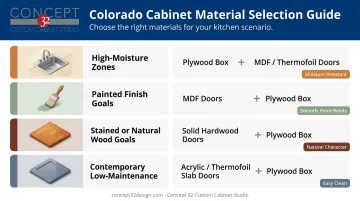
A practical framework:
- High-moisture zones (sink base, dishwasher cabinet, under-sink storage): All-plywood box construction is non-negotiable. Consider MDF or thermofoil/acrylic door options where moisture resistance is the priority.
- Painted finish goals: MDF door faces over plywood boxes — the most stable combination for Colorado's humidity swings.
- Stained or natural wood finish goals: Solid hardwood doors and face frames over plywood boxes — the premium combination, and the dominant 2026 direction.
- Contemporary aesthetic with low maintenance priority: Acrylic or thermofoil slab doors on plywood boxes, with careful placement away from heat sources.
Conclusion
The best cabinet material depends on how a kitchen is actually used, the environment it exists in, and the aesthetic a homeowner wants to live with for decades. There's no single right answer — only the right combination for a specific home.
When you're evaluating custom cabinet bids, go beyond the color samples. Ask directly: What is the box made of? What joint method is used for drawer boxes? Where is the wood sourced, and how is it finished? Those answers tell you more about long-term durability than door style ever will.
Homeowners across Boulder County, Longmont, Fort Collins, Broomfield, and the Northern Front Range can schedule a free in-home consultation with Concept 32 Custom Cabinet Studio — a locally owned studio where master builders craft USA-made, solid wood custom cabinets tailored to each client's space and style.
Reach the studio at 303-682-4052 or visit the showroom at 117 S Sunset St G, Longmont, CO 80501.
Frequently Asked Questions
What are the best custom kitchen cabinet materials for 2025–2026?
Natural hardwood — particularly white oak and walnut — leads 2026 material trends for visible grain and warmth, with all-plywood box construction as the quality standard. Bamboo, FSC-certified wood, and low-VOC finishes are also gaining ground among homeowners who prioritize environmental impact without sacrificing performance.
What is the highest quality material for custom kitchen cabinets?
The highest quality combination is solid hardwood paired with all-plywood box construction — solid wood for face frames, doors, and dovetail drawer boxes; plywood for the structural carcass. This is the specification used by premium custom cabinet builders and delivers the best long-term durability, refinishability, and resale value.
Is solid wood or plywood better for kitchen cabinet boxes?
Plywood is the clear choice for box and carcass construction — it holds screws reliably, resists moisture, and won't swell under kitchen conditions. Solid wood is the right choice for face frames, doors, and drawer fronts. The two materials work together, not in competition.
What cabinet materials hold up best in Colorado's dry climate?
Properly acclimated and sealed solid hardwoods (maple, oak, cherry) and all-plywood box construction both perform well in Colorado's low-humidity environment — bamboo is equally reliable due to its natural dimensional stability. At Concept 32, we spec and finish materials specifically for the Front Range climate to prevent warping and joint movement over time.
Are eco-friendly cabinet materials as durable as traditional options?
Bamboo tests harder than most conventional hardwoods, and FSC-certified solid woods perform identically to non-certified equivalents. Eco-friendly sourcing reflects how and where the material was harvested, not a trade-off in strength or longevity.
How do I choose between MDF and solid wood for painted cabinet doors?
MDF delivers a smoother, grain-free paint surface with less risk of joint cracking, making it the preferred choice for painted door faces — especially in Colorado's dry climate. For stained or natural finishes, solid wood is the better option where visible grain and long-term refinishability matter.